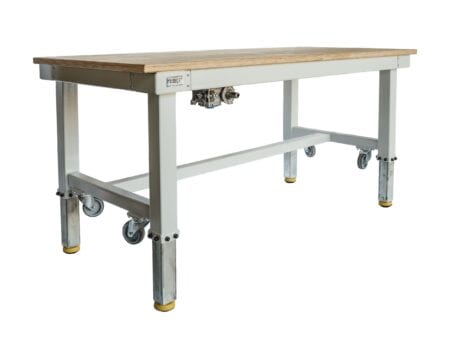
An industrial assembly table is a height-adjustable work table for assembly, inspection and laboratory work. The ergonomic working height depends on the task, the load capacity on the weight of the component. Models such as the PETec Basic carry up to 750 kg, while heavy-duty lines reach well into the tonne range.
What is an industrial assembly table?
An assembly table is more than a fixed workbench. It is a workstation whose height adapts to the person and the task, and which is designed for defined load capacities. In manufacturing it is used to assemble components, in quality assurance as an inspection station, and in the laboratory as a clean, adjustable working surface. The line to a plain work table is drawn at height adjustment: a work table imposes a fixed height, whereas an assembly table sets it.
A welding table, by contrast, is designed for clamping, fixturing and thermal loads. Anyone looking for a workstation for changing operators, varying component heights or mixed seated and standing work is well served by a height-adjustable assembly table. The height-adjustable assembly tables from PETec cover this range from the light single-station solution to the heavy four-leg system.
Typical applications include equipment assembly, jig and fixture building, incoming-goods inspection and laboratory preparation. In every case, adjustability pays off twice over: it improves operators' posture and at the same time speeds up the workflow, because the workpiece is brought into the correct working position without re-gripping. Where several people share the same station, quick height adjustment replaces the fixed compromise with an individually suitable setting.
Which working height is ergonomic?
The ergonomically correct working height depends on the task. Fine work with high visual demands calls for a higher surface, force-intensive assembly for a lower one. The standard DIN EN ISO 14738 serves as a guide, providing reference values for the design of workstations at machinery. For standing work the range is around 95 to 115 cm, depending on the task. Importantly, this is a standards-based reference value, not a fixed manufacturer specification. The exact height follows from body height, viewing distance and the force involved.
This is precisely where a height-adjustable assembly table shows its advantage: it can be set for every person and every work step. When the shift or the product changes, the height is adjusted rather than forcing a compromise. This reduces the strain on the back, shoulders and neck and keeps work productive throughout the day.
Ergonomics under EKAS 6512 and SUVA
In Switzerland, EKAS Directive 6512 sets the framework for safe work equipment. Power-driven lifting and adjusting devices must be inspected regularly by a competent person, and this inspection must be documented. A height-adjustable assembly table can be operated in a SUVA-compliant manner when adjustment, inspection and documentation follow the rules. We deliberately avoid the word certified: what matters is the compliant design and the documented, recurring inspection in operation.
Choosing the right load capacity
Load capacity is the second selection criterion alongside height. What counts is not just the component itself, but the sum of workpiece, fixture and tool, plus a reserve for dynamic load peaks when setting parts down. Planning at the upper limit today means losing no flexibility tomorrow when heavier assemblies are added. The PETec lines cover a wide range, from the light bespoke solution to double-digit tonnes.
Load capacity comparison of the PETec lines
| Line | Design and drive | Load capacity | Typical application |
|---|---|---|---|
| Basic | 2 height-adjustable table legs | up to 750 kg | Assembly and inspection stations in standard operation |
| Advanced | 4 table legs, synchronised adjustment | up to 12 t | Heavy assemblies, large-area platforms |
| Professional | 360-degree swivelling, impact-resistant worktop, electric | up to 1,500 kg | All-round assembly with high accessibility |
| Mono | 1 table leg | up to 300 kg | Compact bespoke solutions and single stations |
| Ecoline | Compact, economical design | depending on configuration | Cost-conscious basic equipment |
The table shows the range: anyone assembling electronics or light components is well served by the Basic or Mono. Anyone lifting complete drivetrains or machine frames needs the synchronised four-leg adjustment of the Advanced. For applications with a high access requirement, the swivelling top of the Professional comes into its own. Industry-specific configurations for automation and manufacturing are shown on our page about lift tables in automation and manufacturing.
Spindle-chain drive instead of hydraulics
The key difference of the PETec assembly tables (occasionally misspelled as Pertec) lies in the drive. The patented spindle-chain drive works without hydraulics. A chain transmits the motion evenly to the spindles of the table legs, so that the worktop adjusts synchronously and without jolts. This is particularly important on multi-leg tables, where every leg must run exactly in step.
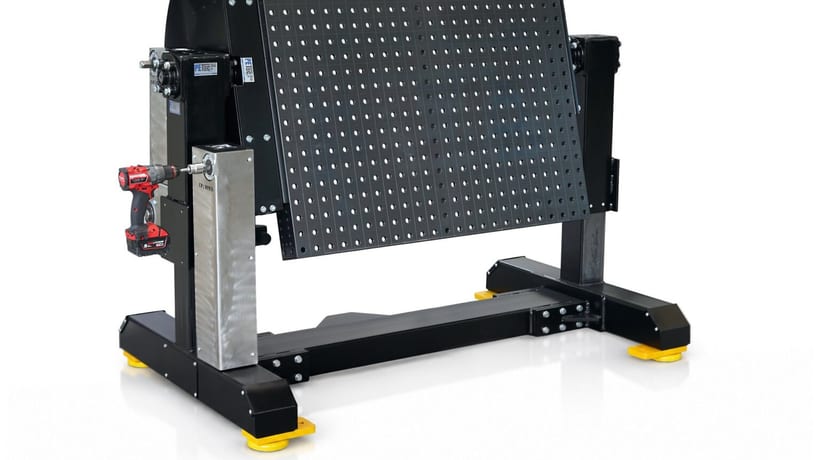
Without hydraulic oil, the risk of leaks is eliminated. This makes the drive suitable for laboratory, pharmaceutical and cleanroom environments where cleanliness is mandatory. Drive is either electric via a 230- or 400-volt connection or by battery, or alternatively mechanical via a cordless screwdriver, hand crank or a ratchet adjustment. This makes it possible to choose, for every workstation, between convenient powered adjustment and power-free operation, an electrically height-adjustable assembly table just as much as a purely mechanical variant.
Assembly table or welding table?
As soon as welding, clamping or heavy joining is involved, a welding table comes into play. PETec welding tables use a top with the widely used Siegmund 16 mm hole system and carry up to 5,000 kg. The continuous hole grid accepts clamping, stop and angle elements and turns the top into a flexible fixture. For pure assembly, inspection and laboratory work, however, this system is not needed: here the smooth, adjustable working surface of the assembly table is what counts. The rule of thumb is: joining and fixturing argues for the welding table, assembly and inspection for the height-adjustable assembly table.
Buying an assembly table in Switzerland
Tirugo is the authorised PETec distributor for the whole of Switzerland. Delivery starts from 7 days, so a new assembly station is ready for use at short notice. Our head office is in Erlenbach ZH, and you are welcome to visit the showroom at Seestrasse 65 in Stäfa by appointment to try the tables on site. You will also find answers on delivery times, standards and inspection in our frequently asked questions.
Before ordering, we clarify the key data with you: load capacity including the fixture, the required height range, the type of drive and the worktop dimensions. This gives you an assembly table that suits the task and meets both the ergonomic and the safety requirements.
Frequently asked questions about assembly tables
Which working height is ergonomic?
As a standards-based reference value under DIN EN ISO 14738, standing work calls for a range of around 95 to 115 cm, depending on the task. The exact height depends on body height, viewing distance and the force involved. A height-adjustable table lets you set both optimally.
How much load capacity is needed?
What matters is the weight of the components plus fixtures and tools, with a reserve. The PETec Basic carries up to 750 kg, the Advanced up to 12 t, the Professional electrically up to 1,500 kg and the Mono up to 300 kg.
What distinguishes an assembly table from a work table?
An assembly table is height-adjustable and designed for defined load capacities. It adapts to the task and to body height and carries heavy assemblies safely, whereas a plain work table imposes a fixed height.
Adjust electrically or manually?
Both are possible. Electrically the table works via a 230- or 400-volt connection or by battery, mechanically via a cordless screwdriver, hand crank or ratchet. The spindle-chain drive works without hydraulics in both cases.
Would you like to specify the right assembly table for your workstation? We advise you on load capacity, height range and drive, and put together the PETec line that fits. Arrange a consultation.