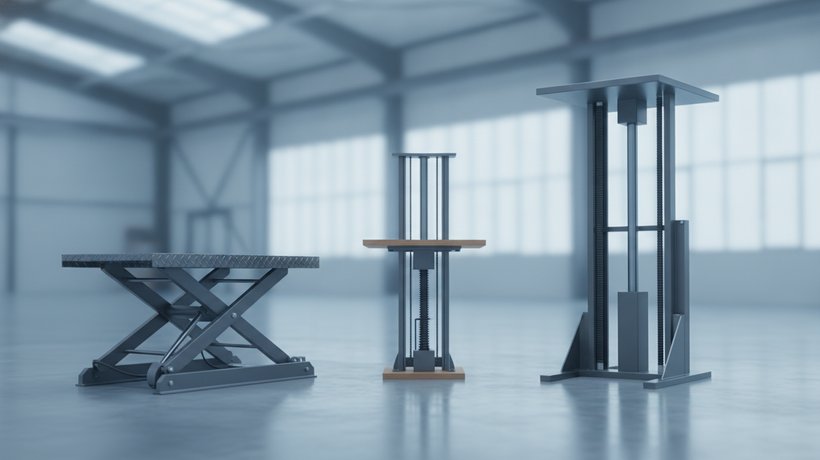
Lift elements are the load-bearing raising and lowering units that bring loads to an ergonomic or process-appropriate working height. Depending on the drive, the main distinction is between scissor, spindle, belt-drive and low-profile lift elements. Which system fits depends on load capacity, stroke, closed height and environment.
What are lift elements? Definition and scope
A lift element is the functional core unit that raises, lowers or holds a load at a defined height. The term captures the load-bearing principle, regardless of whether the end result is a large platform, a narrow beam or a plant component. In practice, most users encounter the lifting unit as a lift table: a lift element with a fixed working surface that fits into a workflow as a standard product or as a bespoke design.
The distinction is worth making, because several terms are often confused in everyday use. A lift table is the ready-to-install design with a platform. A lift element denotes the underlying raising and lowering unit with its drive. To be distinguished from both is the lifting column, a vertically guiding element of linear technology found, for example, in height-adjustable furniture or machine frames. Tirugo deliberately does not carry these lifting columns and electric cylinders of linear technology in its range. Anyone looking for such a guide column is better served by a linear-technology specialist; anyone needing a load-bearing lifting unit for pallets, assemblies or conveyed goods is in the right place with the lift elements described here.
This sets the scope: this guide is about industrial lift elements in table form, that is scissor, spindle, belt-drive and low-profile systems for manufacturing, logistics and process technology. They differ above all in the drive, and it is precisely this drive that determines load capacity, stroke, closed height and the suitable environment.
Drive types compared
The drive type is the most important distinguishing feature of a lift element. It determines how much load is moved, how high and how precise the stroke is, and in which environment the lifting unit may work. Four principles cover the largest part of industrial applications.
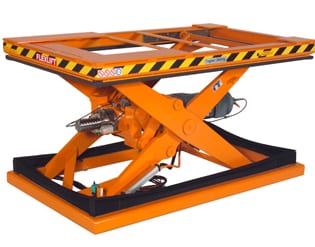
Scissor and hydraulic principle
The scissor lift table is the classic among lift elements. One or more scissor stages are spread apart by a hydraulic cylinder and raise the platform. The principle is robust, broadly scalable and economical, which is why it forms the standard for most lifting tasks. A compact scissor lift table is just as suitable as a work, assembly or packing station as it is for feeding machines. At Tirugo, the Compact Lift Tables FK series from 500 to 10,000 kg covers this standard range. The stroke is large, the accuracy sufficient for standard tasks, and the design withstands harsh operating conditions.
Spindle drive (oil-free)
On the spindle lift table, a mechanical spindle generates the lifting movement rather than a hydraulic cylinder. The drive therefore works oil-free, which rules out oil leaks and qualifies it for cleanroom, pharmaceutical and food production. The second advantage is precision: Flexlift spindle lift tables reach a repeat accuracy of around plus/minus 1 mm and carry up to 12 t. Wherever a load must be positioned exactly and reproducibly, for example at inspection or automation stations, the spindle drive plays to its strength.
Belt drive
The belt-drive lift table RFK is the high-stroke specialist solution. Instead of a classic scissor, wedge plates are used, which a belt drive pushes apart. This patented wedge-spreader system reaches lifting heights of up to 6,000 mm at a very low closed height in the lower end position and load capacities of 500 to 12,000 kg. Designed for high cycle rates in multi-shift operation, the belt drive is the first choice for fully automated transfer systems, conveyor lines and applications in the automotive and steel industries where a fast, smooth lifting movement is required.
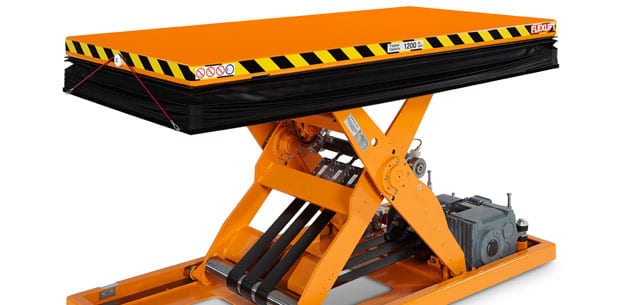
Low-profile
The low-profile design is not a drive of its own, but a design with minimal closed height tailored to ground-level use. Flexlift low-profile lift tables start from a closed height of 55 mm and carry 300 to 8,000 kg depending on the size. Because the platform lies almost flush with the floor in its lowest position, pallets, trolleys and pallet trucks can be driven on without a ramp. For pit installation, the lift element is set flush into the floor, so that a walkable, level working surface is created. Depending on the requirement, this design combines with a scissor or special drive.
Drive types comparison table
| Drive | Load capacity | Stroke / precision | Typical use |
|---|---|---|---|
| Scissor / hydraulic | broadly scalable; Compact FK 500–10,000 kg | large stroke, standard accuracy | universal standard lift table, assembly, feeding |
| Spindle (oil-free) | up to 12 t | repeat accuracy around ±1 mm | cleanroom, pharma, food, inspection stations |
| Belt (wedge-spreader) | 500–12,000 kg | lifting height up to 6,000 mm, high cycle rate | automation, transfer lines, automotive |
| Low-profile | 300–8,000 kg | closed height from 55 mm | pit installation, ground-level loading without a ramp |
The table bundles the documented key figures of the four principles. It also shows that the systems do not replace one another but complement each other: the scissor principle covers the standard, the spindle drive precision, the belt drive large strokes and the low-profile design ground-level installation.
Designs and key figures
Alongside the drive, the design determines whether a lift element fits the space provided. Four key figures belong in every enquiry: load capacity, stroke, closed height and platform size. The load capacity is the sum of payload, fixture and tool plus a reserve for load peaks when setting down. The stroke describes the travel between the lower and upper end position and follows from the required height difference in the process. The closed height in the lowest position is decisive wherever loading is at ground level or into a pit; here the low-profile design plays to its strength from 55 mm. Finally, the platform size must safely accommodate the footprint of the load.
As a rule of thumb: the larger the stroke, the more likely a special system such as the belt drive comes into play. The lower the closed height must be, the more clearly the path leads to the low-profile design. The higher the requirement for cleanliness and positioning accuracy, the more everything speaks for the oil-free spindle drive. And where a robust, economical standard is enough, the compact scissor lift table is the obvious choice. For use in the warehouse and in intralogistics, the overview of lift tables in logistics and warehousing shows suitable configurations.
How do I choose the right lift element?
The selection follows a simple logic: from the load via the process to the environment. Anyone who clarifies the following points in turn quickly narrows down the suitable design.
- Determine the load capacity: add payload plus fixture and tool, plan a reserve for dynamic load peaks and plan at the upper limit so that later assemblies have room.
- Set the stroke: determine the required height difference between the loading and working positions. Large strokes over several metres argue for the belt drive.
- Check the closed height: clarify whether loading is at ground level or into a pit. If so, the path leads to the low-profile design with minimal closed height.
- Assess the environment: cleanroom, pharmaceutical or food demand the oil-free spindle drive. Wet and outdoor areas as well as high cycle rates place additional demands on protection class and design.
- Define the installation situation: free-standing, integrated into a conveyor system or in a floor pit. Integration into existing lines often decides the design.
- Choose platform size and operation: define the footprint of the load, accessibility and control so that the lift element suits the workflow.
This order prevents wrong purchases, because it clarifies the hard constraints first. Only once load capacity, stroke, closed height and environment are fixed does looking at individual models make sense. For mobile lifting tasks away from the classic table form, it is also worth looking at the mini lifts.
Standards and safety
For lift tables, the EN 1570 series of standards applies, which defines the safety requirements for fixed lift tables. Among other things, it governs crushing and shearing points, load-bearing components and the safeguarding of the movement. Which requirements apply with several fixed landings is explained in detail in our article EN 1570-2 explained. In Switzerland, the operational framework of EKAS and SUVA is added: power-driven lifting equipment must be inspected regularly by a competent person, and this inspection must be documented. A lift element can be operated in a SUVA-compliant manner when design, inspection and documentation follow the rules. We deliberately do not speak of certification; what matters is the compliant design and the recurring, documented inspection in operation.
Lift elements from Tirugo at a glance
Tirugo is the authorised Flexlift dealer for the whole of Switzerland and covers the four described drive principles with its own product lines. This makes it possible to assemble the right lift element for every requirement:
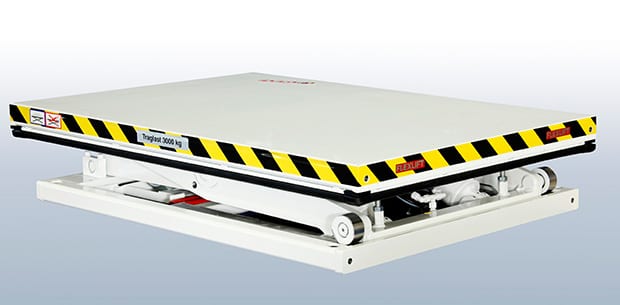
- Low-profile lift tables with a closed height from 55 mm and 300 to 8,000 kg load capacity for ground-level use and pit installation.
- Oil-free spindle lift tables with around plus/minus 1 mm repeat accuracy and up to 12 t load capacity for cleanroom, pharmaceutical and precision tasks.
- Belt-drive lift tables with wedge-spreader system, lifting heights up to 6,000 mm and 500 to 12,000 kg for automation and transfer lines.
- Compact lift tables of the FK series with 500 to 10,000 kg for robust standard lifting tasks in assembly and logistics.
Which line fits in the individual case depends on the key data clarified in the checklist. We are happy to specify the right lift element together with you.
Frequently asked questions about lift elements
What is the difference between a lift table and a lift element?
Lift element is the umbrella term for the load-bearing raising and lowering unit. A lift table is its most common design: a lift element with a fixed platform. The term lift element therefore denotes the drive and lifting unit regardless of the table form.
Which drive types are used in lift elements?
Four principles are common: scissor and hydraulic drive for robust standard strokes, oil-free spindle drive for high precision, belt drive for large lifting heights and the low-profile design with minimal closed height for ground-level installation.
What does oil-free mean on spindle lift tables?
Oil-free means the lifting movement is generated by a mechanical spindle rather than a hydraulic cylinder. Oil leaks are thereby ruled out, which is why the drive is suitable for cleanroom, pharmaceutical and food. The repeat accuracy is around plus/minus 1 mm.
Which lift element is suitable for installation in a floor pit?
Low-profile lift tables are suitable for pit installation. They start from a closed height of 55 mm, can be set flush and carry 300 to 8,000 kg depending on the size. Pallets and trolleys are driven on without a ramp.
Would you like to specify the right lift element for your application? We advise you on load capacity, stroke, closed height and drive, and put together the suitable Flexlift line. Submit your enquiry.