Anyone looking to buy a lift table often searches for a price first and finds a contact form instead. This is not evasion; it has a technical reason: an industrial lift table is designed for its task, and this task looks different in every business. This article explains why the route leads via a quote, which six details your supplier needs for it, and what the lift table enquiry process looks like, from the first contact through consultation to delivery and commissioning. At the end you will find a short checklist that helps you prepare when you want to request a lifting table quote quickly and precisely.
Why there are no off-the-shelf prices for lift tables
An industrial lift table is rarely a product straight from a catalogue page. Load capacity, platform size, travel, installation situation, drive and environment interact in the design: two tables that look the same at first glance can differ considerably in scissor assembly, hydraulics, safety equipment and platform version. Added to this are options such as stop edges, roll-off guards, control variants or special surfaces, which depend on the specific process.
This is why suppliers work with quotes rather than list prices. That is not a lack of transparency; on the contrary, transparency comes from the scope of services. A serious quote records which version is offered, which services and options are included, and which details the design is based on. This way you know exactly what you will receive, and you can compare offers on their content rather than merely placing numbers side by side.
The quote checklist: the six details your supplier needs
For a sound quote, your supplier needs six core details. They do not have to be accurate to the millimetre; realistic ranges are enough to start with:
- Load capacity: How heavy is the load, and how is it placed on the table, for example as a pallet, a mesh box or by hand? Unevenly distributed or off-centre loads should be mentioned as well.
- Platform size: Which length and width does the platform need so that the load rests securely and handling works within the process?
- Travel and heights: From which lowest to which highest position should the table move? The collapsed height and the required top height largely determine the design.
- Installation situation: Does the table stand freely on the floor, does it need to be accessible for pallet trucks, or does a pit exist or is one planned? The question pit yes or no belongs in every enquiry.
- Drive type: Are there requirements or preferences for the drive, such as hydraulic, spindle or belt, for example because of noise, precision or maintenance?
- Environment and operating conditions: Where and how intensively will the table be used? Relevant factors include indoor or outdoor use, temperature, humidity, hygiene requirements, duty cycle and cycles per hour.
With these six points your supplier can narrow down the design and ask targeted questions. A simple sketch of the installation situation or a photo of the site often replaces several rounds of questions.
From enquiry to quote: the process step by step
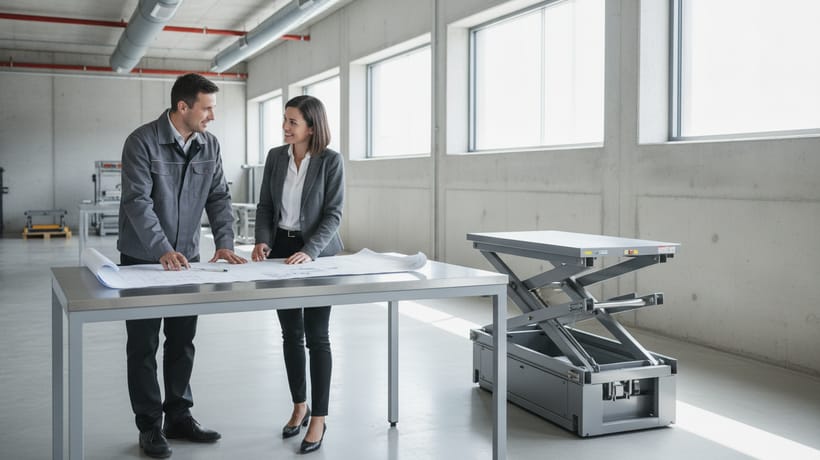
It starts with the enquiry, by phone, email or contact form, ideally already containing the six core details. Follow-up questions usually come next: the supplier clarifies open points about the application, discusses possible variants and points out aspects still missing from the enquiry. This consultation can take place by phone, in writing or in a personal meeting where technical drawings and the installation situation are reviewed together.
Once the requirements are clear, you receive the quote with a scope of services: version, included services, options and delivery time. Now a careful review pays off, with questions welcome, until every point is clear. With the order and the order confirmation, the delivery time becomes binding. Tirugo sees this route as one continuous process from planning to commissioning: the details from your enquiry flow directly into design, ordering and delivery.
Putting delivery times into perspective
A realistic expectation helps with planning: standard units usually have delivery times of 2 to 6 weeks from order, depending on the model and availability at the manufacturer. Custom builds and system configurations, for example with a customer-specific platform or a control interface, require 8 to 14 weeks. The binding delivery time is communicated with the order confirmation.
Depending on the version and availability, delivery times from 7 days are also possible, for instance when a standard model is available at short notice. Whether this applies to your configuration is clarified during the consultation; such a time frame is not a blanket promise. If you have a fixed date, such as a conversion or a planned installation window, it is best to mention it in the enquiry. This allows feasibility to be checked early and the quote to be aligned accordingly.
From delivery to commissioning
Delivery alone does not put a lift table into service. Before commissioning, several points need to be clarified, ideally during the quotation phase: How does the unit get to the installation site, meaning access, unloading and in-house transport? Is the floor level and able to carry the load, and will any pit be ready on schedule? Is the electrical connection with the right supply values available?
Just as important are the responsibilities: clarify with your supplier who carries out the installation, who makes the electrical connection, who checks the equipment before first use and who instructs the operating personnel. These points belong in the scope of services of the quote, so that no questions remain open before commissioning and everyone involved knows which part is theirs.
How to prepare your enquiry
A compact summary of the key points is all your enquiry needs:
- Load capacity and type of load
- Platform size (length and width)
- Travel with lowest and highest position
- Installation situation, including the question pit yes or no
- Drive type, if there are requirements or preferences
- Environment and operating conditions, plus the desired delivery date
With this, your enquiry is ready to go. You can reach Tirugo via the contact page, by phone or by email. If you would like to see equipment in person before deciding, you can also arrange an appointment at the showroom at Seestrasse 65 in Stäfa and discuss your application directly at the machine.
Frequently asked questions about lift table quotes
Which details does a supplier need for a lift table quote?
Six details form the basis: the load capacity including how the load is placed, the required platform size, the travel with the lowest and highest positions, the installation situation including whether a pit exists or is planned, the preferred drive type, and the ambient and operating conditions, such as cycle rate, temperature or hygiene requirements. A simple sketch or a photo of the installation site helps as well.
Why does Tirugo not quote standard list prices?
Because a lift table is designed for the specific application. Load capacity, platform size, travel, installation situation, drive and environment all influence the construction and therefore the price. A quote with a scope of services makes transparent which version and which services are included, and is therefore more meaningful than a list price that ignores the application.
How long does delivery of a lift table take?
Standard units usually have delivery times of 2 to 6 weeks from order; custom builds and system configurations require 8 to 14 weeks. Depending on the version and availability, delivery times from 7 days are possible. Your supplier confirms the binding delivery time with the order confirmation.
What happens between the enquiry and the quote?
After the enquiry there are usually follow-up questions about the application, by phone, by email or in a consultation. Once load capacity, dimensions, travel, installation situation, drive and environment are clarified, the supplier prepares a quote with a scope of services. On this basis you can compare, ask questions and place the order.
Which details speed up the quote?
The more complete the six core details, the fewer follow-up questions are needed: load capacity, platform size, travel and heights, installation situation including the pit question, drive type, and ambient and operating conditions. A sketch or photos of the installation site and the desired delivery date are also helpful.
Would you like to make a specific enquiry or discuss your application first? We advise you across Switzerland and prepare a quote with a transparent scope of services. Request your lift table quote.