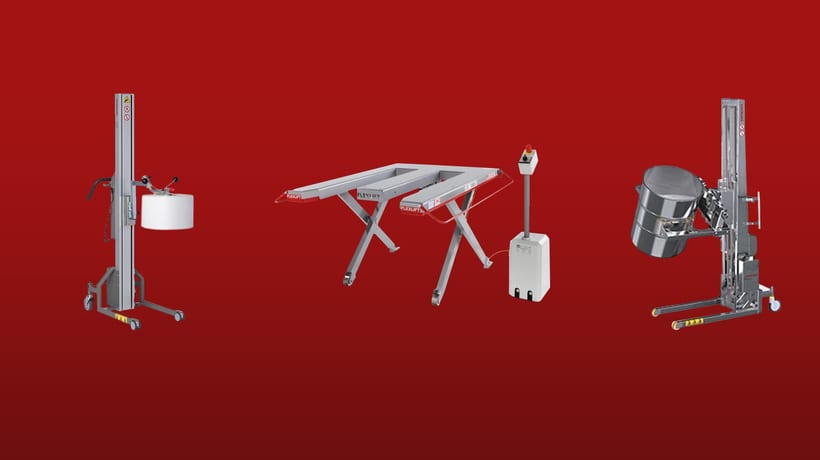
Not every site has a fixed loading ramp at docking height. Where loading takes place at ground level, where vehicles of different bed heights dock, or where no ramp level exists, a dock lift table bridges the height difference between the floor and the vehicle bed. This guide explains what defines a dock lift table, when it is the right choice over a ramp, dock leveller or tail lift, and which points you should clarify for planning, safety and outdoor installation.
What is a dock lift table?
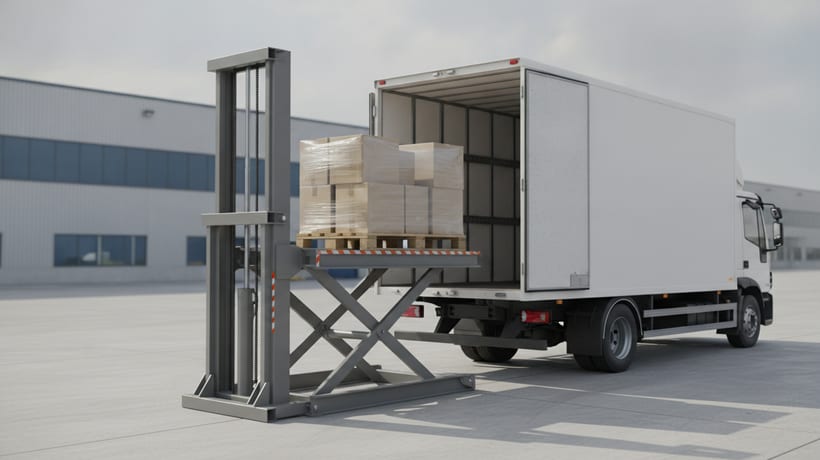
A dock lift table is a lift table used at a loading point to move goods between ground level and the bed of a vehicle. Technically it is usually a robust scissor lift table that takes on a pallet, a trolley or a forklift and raises it to the required height. Instead of pushing or driving the load up a sloped ramp, it is lifted vertically and guided. In this way the dock lift table replaces or supplements the classic loading ramp wherever one is not structurally available or not sensible. This task also goes by the terms loading lift table, loading bay lift or, in German, Verladehubtisch.
The key difference from a pure ergonomic workplace lift table lies in the operating environment: a dock lift table works at the interface between inside and outside, often in alternating operation with forklifts, and frequently in the open air. That places particular demands on load capacity, platform size, safety and weather resistance.
Dock lift table, ramp or dock leveller: when to use which?
Several solutions are available for goods receipt and dispatch; they do not exclude one another but complement each other depending on the situation. A brief overview helps to place them:
- Fixed loading ramp: built structurally at docking height. Economical where vehicles of similar bed height regularly dock at a suitable door. It is fixed in place and set to one height level.
- Dock leveller: bridges the remaining gap and the small height difference to the vehicle at an existing ramp. It requires a ramp already in place and only compensates for a limited range.
- Tail lift: a lifting platform mounted on the vehicle. It is mobile and vehicle-bound, but only available where the suitably equipped vehicle pulls up.
- Dock lift table: a stationary lifting unit at the loading point. It bridges larger and varying height differences and suits cases with no docking level, different vehicle heights or ground-level loading.
As a rule of thumb: the more uniform the vehicle mix and the more fixed the docking level, the more a ramp with a dock leveller suffices. The greater the height differences and the more flexible the loading point needs to be, the more the starting position argues for a dock lift table. Which combination is ultimately the most economical depends on frequency, vehicle mix and the structural situation.
Planning: the key questions up front
A dock lift table is specified for the specific loading point. Clarifying the following points before enquiring leads to a sound solution more quickly.
Load capacity
What counts is the actual load on the platform. If a forklift drives onto the table, its own weight adds to the payload; an electric forklift often weighs a multiple of the pallet load. In addition, plan a reserve for dynamic load peaks when driving on and setting down. A generous specification creates safety and room for heavier load units.
Platform size and height difference
The platform must safely accommodate the load unit and, where necessary, carry the forklift driving on. A dock lift table moves between ground level and the vehicle bed; the height difference to bridge and how it varies across the vehicle mix determine the required stroke. These constraints set the size before individual models come into consideration.
Pit or surface mounting with an access ramp
There are two basic routes for the installation situation. If the dock lift table is set flush into a pit, a level surface is created onto which forklifts drive without a step. If it is placed on the floor, a fixed access ramp opens up the platform. The two versions differ in construction effort, accessibility and later flexibility. Which one fits depends on the structural conditions, the drainage and the intended use.
Safety at the loading point
Stationary lift tables fall under the European EN 1570 series of safety standards. It defines the fundamental safety requirements for lift tables; the version for installations that serve several levels is covered in a separate part. What this means in detail and which protective measures lie behind it is set out in our article on EN 1570-2. At a loading point, alongside the standard, the protection of shear and crush points, the fall protection at the open sides of the raised platform and a clearly operated control secured against unintended actuation are especially relevant. The specific safety concept belongs in the engineering phase and is matched to the individual loading point.
Outdoor installation and weather
Many loading points are outdoors or at the transition between hall and yard. Outdoor installation therefore raises additional points to clarify: a suitable protection class against moisture and dust, effective corrosion protection, the drainage of a pit and the handling of frost and low temperatures. UV exposure and strongly fluctuating temperatures also act on components and hydraulics. These requirements feed into the specification early, so that the loading solution works reliably over the long term.
Planning the right loading solution with Tirugo
Tirugo is the authorised Flexlift dealer for the whole of Switzerland and supports loading tasks as a consulting and project partner. A dock lift table is usually a tailored solution, matched to height difference, vehicle mix, load capacity and installation situation. A robust scissor lift table often serves as the basis: the manufacturer Flexlift lists its FK compact scissor lift table explicitly for use as a loading lift table, with platforms from around 1250 x 800 mm up to 4000 x 1500 mm depending on version. Which configuration carries in the individual case is something we clarify together with you.
For an overview of the ergonomic and logistics lift table applications, see our page on lift tables for logistics and warehousing. To specify your loading point, we record height difference, load, platform dimension, frequency and installation situation and propose the suitable solution.
Frequently asked questions about dock lift tables
What is a dock lift table?
A dock lift table is a lift table, usually of scissor design, that bridges the height difference between ground level and the bed of a truck at a loading point. It raises pallets, trolleys or a forklift to the required height and so enables loading and unloading where no fixed loading ramp is available.
Dock lift table or loading ramp: which is better?
A fixed loading ramp is the economical solution where vehicles with the same bed height regularly dock at a structurally suitable door. A dock lift table plays to its strength where different vehicle heights are served, where no docking level exists or where loading takes place at ground level. The right choice depends on vehicle mix, frequency and the structural situation.
Does a dock lift table need a pit?
Not necessarily. A dock lift table can be set flush into a pit so that forklifts drive on level, or placed on the floor and accessed by an access ramp. Pit and surface-mounted solutions differ in construction effort, accessibility and flexibility; which version fits is clarified from your structural conditions.
What information does Tirugo need for a loading solution?
Helpful details are the height difference to bridge, the load capacity including the forklift if it drives on, the required platform dimension, the frequency and the installation situation with pit or surface mounting. For outdoor installations, weather, drainage and corrosion protection are added. We work out the exact specification together with you.
Are you planning a loading point without a fixed ramp, or do you want to supplement an existing solution? We advise you on height difference, load capacity, platform, installation and safety and propose the suitable loading solution. Submit your enquiry.