Anyone buying a lift table soon faces the question of the drive: electric or hydraulic? Strictly speaking, the question is imprecise, because an industrial hydraulic lift table is usually powered by an electric motor that drives a hydraulic pump. The real difference is how the force reaches the platform: through oil and cylinders (electrohydraulic) or purely mechanically through a spindle or a belt (electromechanical). This guide compares both principles against the criteria that matter in practice and ends with a decision aid for your application.
Electrohydraulic and electromechanical: what is the difference?
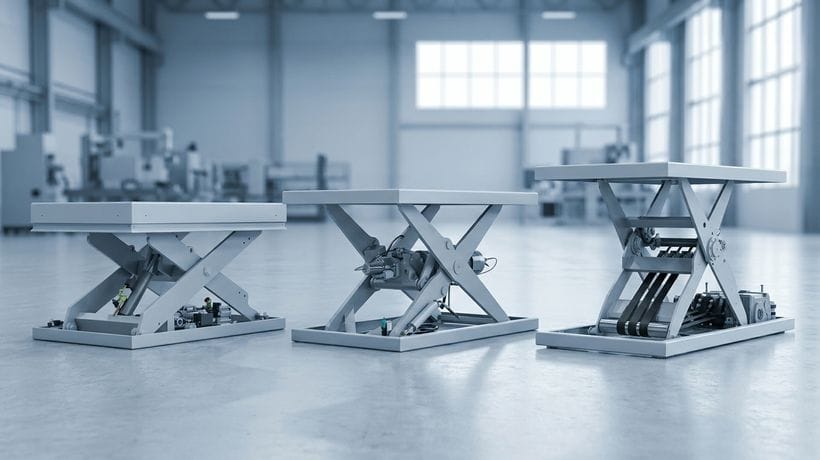
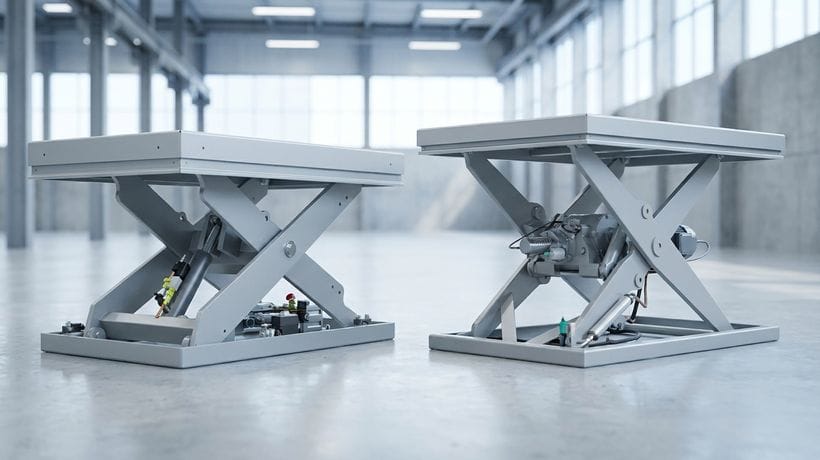
In an electrohydraulic lift table, an electric motor drives a pump that feeds hydraulic oil into one or more cylinders. The cylinders spread the scissors and raise the platform; when lowering, the oil flows back in a controlled way. This is the classic scissor lift table principle and the standard for most lifting tasks.
An electromechanical lift table has no oil circuit at all. The electric motor moves the platform through a mechanical element. In the Flexlift range, which Tirugo supplies throughout Switzerland, there are two such systems: the SFL spindle lift table, where a spindle generates the lifting movement, and the RFK belt lift table, where a belt drive pushes wedge plates apart.
If you are searching for an “electric lift table”, it is worth being precise: do you mean a table with an electric motor, which applies to most industrial lift tables, or a table without any hydraulic oil? For the selection, the second question is the one that counts.
The hydraulic lift table: robust and economical
Hydraulic lift tables are robust and economical for classic lifting loads. The scissor principle scales well, copes with harsh operating conditions and covers most tasks in assembly, warehousing and machine loading. At Tirugo, this is the domain of the FK compact series with a robust hydraulic scissor design, load capacities from 500 to 10,000 kg and a working stroke of up to 1,600 mm.
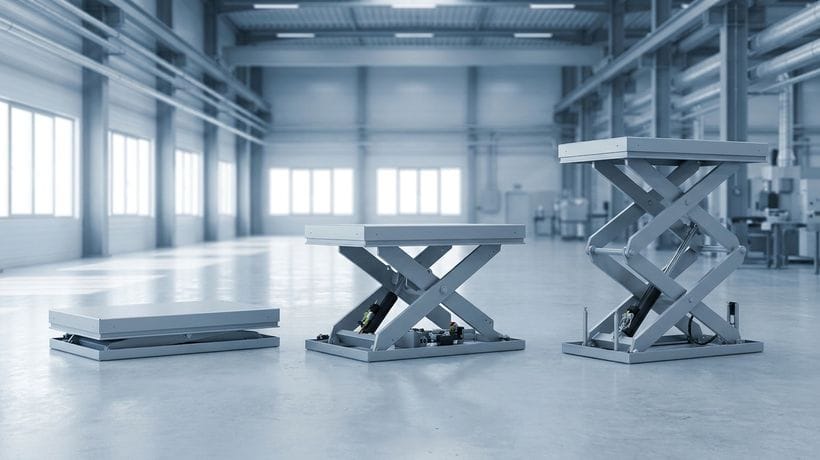
Hydraulics are also common in low-profile designs. On the FE-A flat form lift table, the hydraulic power unit and control are mounted directly on the platform, and power is supplied from above via a spiral cable. This avoids trip hazards from floor cables at the workstation.
The limits: wherever there is oil in the system, there is a basic risk of leakage. In cleanrooms, pharmaceutical production and food processing, many operators are not willing to take that risk. In addition, an oil circuit positions less precisely than a mechanical spindle.
The electromechanical lift table: oil-free and precise
Spindle drive: Flexlift SFL
The SFL spindle lift table uses an oil-free electromechanical spindle drive: no hydraulics, no risk of leaks, no fire hazard from hydraulic oil. Thanks to a direct spindle drive without play, it achieves a positioning accuracy of ±1 mm and carries up to 12,000 kg. The overall height starts at 200 mm, the standard lifting height is up to 600 mm, and special strokes are available on request. Typical applications are precision assembly, automated test stations and any area where no oil may escape. Details are on our page about SFL spindle lift tables.
Belt drive: Flexlift RFK
The RFK belt lift table is the high-lift solution among electromechanical drives. Instead of scissors, a belt drive pushes two counter-rotating wedge plates apart. This patented wedge spreading system reaches lifting heights of up to 6,000 mm with a very low overall height, carries 500 to 12,000 kg and is designed for high cycle rates in multi-shift operation. More on our page about RFK belt lift tables.
The FE flat form series for pallets sits in between: it is available with either a hydraulic or an electromechanical drive, so the drive type can follow the environment.
Electric or hydraulic: comparison by five criteria
| Criterion | Hydraulic (electrohydraulic) | Electromechanical (spindle, belt) |
|---|---|---|
| Oil and cleanliness | Hydraulic oil in the system, basic risk of leakage | Oil-free, no risk of leakage, no fire hazard from oil |
| Positioning accuracy | Sufficient for standard tasks | SFL spindle: ±1 mm, reproducible |
| Cycle rate and automation | Proven, FK also for high cycle rates in multi-shift operation | RFK belt for fully automated lines, SFL spindle for test and assembly stations |
| Load capacity and stroke | FK compact 500–10,000 kg, working stroke up to 1,600 mm | SFL up to 12,000 kg, standard stroke up to 600 mm; RFK 500–12,000 kg, stroke up to 6,000 mm |
| Maintenance | Hydraulics: keep an eye on oil level, hoses and seals | Mechanics: check spindle, belt and bearings; no hydraulic oil to check or dispose of |
Oil, cleanrooms and food
The strongest argument for an electromechanical drive is the absence of oil. For cleanrooms, pharmaceuticals and food, the oil-free spindle drive is therefore the obvious choice. For these industries there are also food-grade versions with approved lubricants and stainless steel components. Our page on lift tables for pharma and food gives an overview.
Positioning accuracy and automation
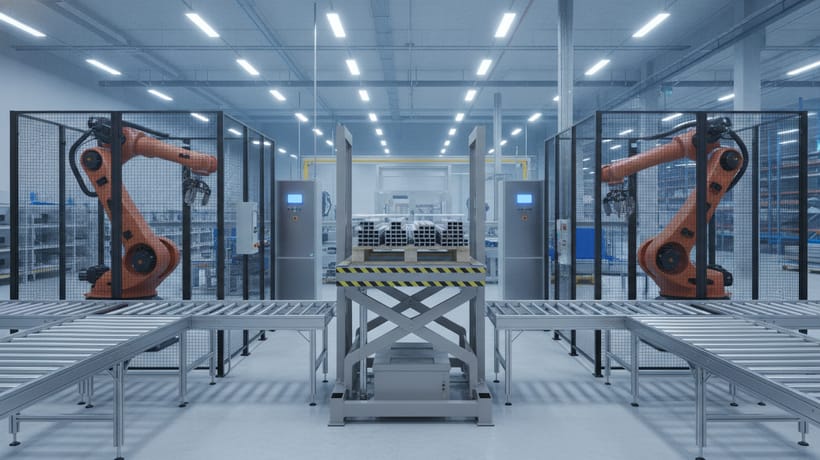
If a load must return to exactly the same height again and again, for example at a test station or at the handover to a robot, the spindle plays to its strengths. The RFK belt lift table is designed for fully automated conveyor and transfer lines with high cycle rates. Hydraulic scissor lift tables are also widely used in automation where their accuracy is sufficient for the process. Our article on lift table line integration explains how lift tables are integrated into lines.
Load capacity, stroke and overall height
In terms of load capacity, both worlds are close in the Flexlift range: hydraulic up to 10,000 kg with the FK series, electromechanical up to 12,000 kg with SFL and RFK. The differences show in the stroke: the spindle lift table is designed for up to 600 mm as standard, the belt lift table reaches up to 6,000 mm. Where the overall height must be minimal, the flat form design with an overall height from 55 mm comes into play.
Maintenance and inspection
Regardless of the drive, in Switzerland powered lifting platforms and lift tables must be inspected annually. Maintenance differs mainly in content: with hydraulics, the focus is on oil, hoses and seals; with electromechanical drives, on the mechanical components. The Tirugo service team has experience in hydraulics, electrics and mechanics and looks after equipment from all manufacturers throughout Switzerland.
Which drive for a scissor lift table?
For the classic scissor lift table, the electrohydraulic drive is the standard: a hydraulic cylinder spreads the scissors and an electric motor drives the pump. Depending on the design, however, a lift table can also be driven by a spindle, a belt or a push chain. If you must avoid oil altogether or need millimetre positioning, choose an electromechanical design instead of a hydraulic scissor lift table: the SFL spindle lift table for precision or the RFK belt lift table for large strokes. Incidentally, the height-adjustable PETec work tables also use an oil-free spindle chain system instead of hydraulics.
Decision aid: finding the right drive
- Hydraulic if you have a robust standard lifting task in assembly, warehousing or machine loading, no cleanroom is required and standard accuracy is enough.
- Electromechanical with spindle if cleanroom, pharma or food applications require oil-free operation or the load must be positioned reproducibly to ±1 mm.
- Electromechanical with belt if you need lifting heights of several metres, high cycle rates and integration into conveyor and transfer systems.
- FE flat form if pallets are taken over at floor level and the drive type should be chosen according to the environment.
The drive is only one part of the selection. Our lift table selection guide shows how it interacts with design, stroke, overall height and platform. For a technical overview of all principles, read our article Lift elements: types, drives and selection.
Frequently asked questions about electric and hydraulic lift tables
Is a hydraulic lift table also electric?
In industry, usually yes: an electric motor drives the hydraulic pump, and the oil raises the platform via cylinders. This is why it is called an electrohydraulic drive. An electromechanical lift table, by contrast, works entirely without oil, using a spindle or a belt.
Which drive is suitable for cleanrooms, pharma and food?
An electromechanical drive, because it works without hydraulic oil: no risk of leakage and no fire hazard from oil. The Flexlift SFL spindle lift table is designed for this, carries up to 12,000 kg and positions to ±1 mm.
Is an electromechanical lift table more accurate than a hydraulic one?
Yes, electromechanical drives position more precisely. Thanks to its direct spindle drive without play, the SFL spindle lift table achieves a positioning accuracy of ±1 mm. For many standard tasks in assembly and warehousing, however, the accuracy of a hydraulic lift table is sufficient.
Which drive achieves the greatest lifting heights?
In the Flexlift range, the RFK belt lift table: its wedge spreading system with belt drive reaches lifting heights of up to 6,000 mm with a very low overall height and load capacities from 500 to 12,000 kg.
Does Tirugo service hydraulic and electromechanical lift tables?
Yes. The Tirugo service team has many years of experience in the hydraulics, electrics and mechanics of lifting and conveying equipment and services equipment from all manufacturers throughout Switzerland, including the annual inspection with a written inspection report.
Not sure whether a hydraulic or an electromechanical lift table suits your application? We clarify load, stroke, environment and cycle rate with you and recommend the right drive. Submit your enquiry.