A lift table brings loads safely and repeatably to the right working or process height. Which design fits depends on a few clearly definable key figures: load capacity, stroke, closed height and operating environment. This guide sorts the common designs, shows where the single and double scissor, the low-profile, spindle and belt-drive types have their strengths, and sums up the six questions you should clarify before making an enquiry.
The main lift table designs at a glance
Lift tables differ above all in how they raise the platform. Four designs cover the largest part of industrial applications. They do not replace one another but complement each other: the scissor stands for the robust standard, the low-profile for ground-level installation, the spindle drive for precision and the belt drive for large lifting heights.
Scissor lift table: single and double scissor
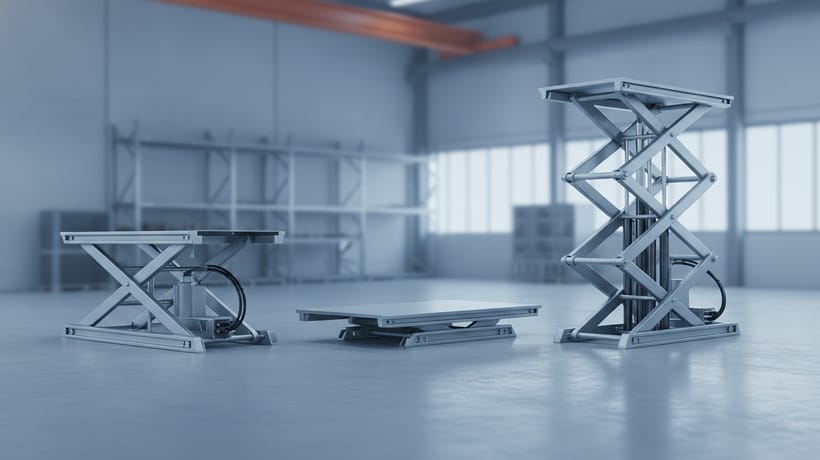
The scissor lift table is the classic. One or more scissor stages are spread apart to raise the platform. In the single scissor, a single scissor stage does the work; this design is robust, economical and covers the usual stroke range. It serves equally well as a work, assembly or packing station and for feeding machines. In the double scissor, two scissor stages are arranged one above the other, so that a greater stroke can be achieved on the same footprint. The Compact Lift Tables FK series covers this standard range with load capacities from 500 to 10,000 kg and a lift travel of up to 1,600 mm, and is partly available from stock. For very large strokes the classic scissor reaches its limits; special drives such as the belt system then come into play. How the drives work technically and compare in detail is set out in our article on lift elements, types and drives.
Low-profile lift table
The low-profile design is tailored to ground-level use. Low-profile lift tables start from a closed height of 55 mm, so that pallets, trolleys and pallet trucks can be driven on almost flush with the floor in the lowest position. Across the whole range, load capacities run from 300 to 8,000 kg. The FE model carries 300 to 2,000 kg and is available in standard widths of 910 mm for the Euro pallet and 1,150 mm for the industrial pallet, with special widths on request. The F-CE model carries 300 to 2,500 kg, reaches lifting heights of up to 950 mm and can be set at ground level with an access ramp. For pit installation, the table is set flush into the floor, so that a walkable, level working surface is created.
Spindle lift table (oil-free)
On the spindle lift table, a mechanical spindle generates the lifting movement instead of a hydraulic cylinder. The drive therefore works oil-free, which rules out leaks and qualifies the design for cleanroom, pharmaceutical and food production. Spindle Lift Tables SFL carry up to 12,000 kg, position with an accuracy of around plus/minus 1 mm and start from a closed height of 200 mm. The standard lifting height reaches up to 600 mm, with special strokes available on request. Wherever a load must be positioned exactly and reproducibly, the spindle drive plays to its strength.
Belt-drive lift table
The belt-drive lift table is the high-stroke solution. Instead of a classic scissor, wedge plates are used, which a belt drive pushes apart. With this patented wedge-spreader system, Belt-Drive Lift Tables RFK reach lifting heights of up to 6,000 mm at a low closed height and load capacities from 500 to 12,000 kg. Designed for high cycle rates, they are the first choice for automation, transfer lines and applications in the automotive and logistics sectors where a fast, smooth lifting movement is required.
Six questions before your enquiry
Anyone who clarifies the following six points before enquiring quickly narrows down the suitable design and receives a sound quotation. The order runs from the load via the process to the environment.
- How high is the actual load capacity? Add up payload, fixture and tool, and plan a reserve for load peaks when setting down. Planning at the upper limit keeps room for heavier assemblies later on.
- Which stroke and which closed height? The stroke follows from the height difference between the loading and working positions. The closed height in the lowest position matters wherever loading is at ground level or into a pit; here the path leads to the low-profile lift table from 55 mm. Large strokes over several metres argue for the belt drive.
- How large does the platform need to be? The bearing surface must safely accommodate the footprint of the load and keep access to the workflow open. On low-profile models, standard widths of 910 mm for the Euro pallet and 1,150 mm for the industrial pallet are common, with further dimensions on request.
- In which environment is the work carried out? Cleanroom, pharmaceutical and food production call for the oil-free spindle drive with no risk of leaks. Wet, outdoor or dusty areas place additional demands on protection class and material that need clarifying in advance.
- What do cycle rate and load handling look like in operation? How often the table lifts, whether in single or multi-shift operation, and whether the load is placed centrally or off-centre, significantly affects the design. These points cannot be quantified across the board; we define the specific values together with you.
- What does the installation situation look like? Free-standing, integrated into a conveyor system or in a floor pit: the integration into existing processes often decides the design, and with it the anchoring, access and control.
This order prevents wrong purchases, because it clarifies the hard constraints first. Only once load capacity, stroke, closed height and environment are fixed does looking at individual models make sense.
Lift table or hoist? The difference
A lift table and a hoist solve different tasks, even though both move loads. A lift table takes the load flat on a platform and raises it, guided from below, to a fixed working or process height. The movement is vertical, repeatable and usually fixed in place within a workflow. A crane or other hoist, by contrast, hangs the load from a hook or sling and moves it freely through the room.
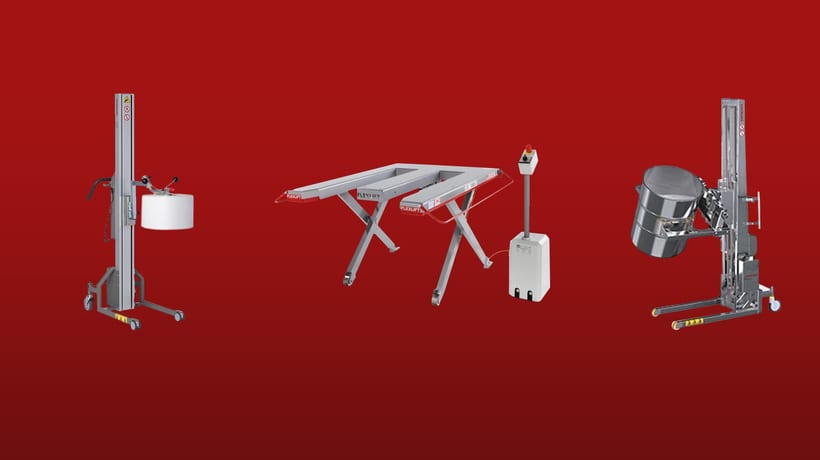
This gives a simple rule of thumb: if a load is repeatedly taken flat and brought to a defined height, for example at an assembly, packing or feeding station, the lift table is the right solution. If instead the load has to be moved freely through the room, transported along changing routes or lifted and held, the crane and hoist play to their strength. For mobile lifting tasks away from the fixed table form, Tirugo also offers mini lifts that lift, tilt, turn and travel with loads up to 400 kg.
Finding the right series with Tirugo
Tirugo is the authorised Flexlift dealer for the whole of Switzerland and covers the designs described with four product lines. This makes it possible to put together the right lift table for every requirement:
- Compact Lift Tables FK on the scissor principle from 500 to 10,000 kg for robust standard lifting tasks, partly available from stock.
- Low-profile lift tables FE and F-CE with a closed height from 55 mm for ground-level loading and pit installation, in a range from 300 to 8,000 kg.
- Spindle Lift Tables SFL oil-free, with around plus/minus 1 mm repeat accuracy and up to 12,000 kg for cleanroom, pharmaceutical and precision tasks.
- Belt-Drive Lift Tables RFK with wedge-spreader system, lifting heights up to 6,000 mm and 500 to 12,000 kg for automation and transfer lines.
Fixed lift tables fall under the EN 1570 safety standard; what this means in detail is explained in our article on EN 1570-2. For many standard models, the delivery time starts from seven days. Which line fits in the individual case depends on the key data clarified above. When it comes to ergonomic assembly workstations with a height-adjustable work surface, it is also worth looking at height-adjustable assembly tables.
Frequently asked questions about lift table selection
Which lift table design suits my application?
It depends on four key figures: load capacity, stroke, closed height and operating environment. The scissor lift table is the robust standard, the oil-free spindle lift table scores on precision and in cleanroom, pharmaceutical and food, the belt-drive lift table handles large lifting heights and high cycle rates, and the low-profile lift table is intended for ground-level and pit installation.
What is the difference between a single and a double scissor?
A single scissor has one scissor stage and covers the usual stroke range economically. In the double scissor, two scissor stages are arranged one above the other, so that a greater stroke can be reached on the same footprint. For very large strokes, special drives such as the belt system are used instead of the scissor.
What information does Tirugo need for a lift table enquiry?
Helpful details are the load capacity including fixture and tool, the required stroke, the maximum permissible closed height, the platform dimension, the operating environment and the installation situation. Information on the cycle rate and on whether the load is placed centrally or off-centre completes the picture. We clarify the exact specification together with you.
Lift table or crane: what is the difference?
A lift table takes the load flat on a platform and raises it, guided from below, to a fixed working height. A crane or hoist hangs the load from a sling and moves it freely through the room. For recurring lifts to a defined height, the lift table is the right solution; for moving loads freely through the room, the crane.
Would you like to specify the right lift table for your application? We advise you on load capacity, stroke, closed height, environment and drive, and put together the suitable Flexlift line. Submit your enquiry.