Automated production lines only work when material is available at the right time at the right height. Lift tables play an unobtrusive but central part in this: they bridge height differences between conveyor levels, buffer loads between process steps and hand pallets or workpiece carriers over to the next station. This article explains how this kind of automated lift table integration works in principle: which interfaces a lift table uses to communicate with the line control system, why positioning accuracy and repeatability decide how reliable automated transfers are, how cycle rates shape the sizing of the equipment, and which safeguards interact in an automated cell. It is written for anyone planning line integration and wanting to understand the foundations of lifting technology in industrial automation.
Why lift tables in automated lines?
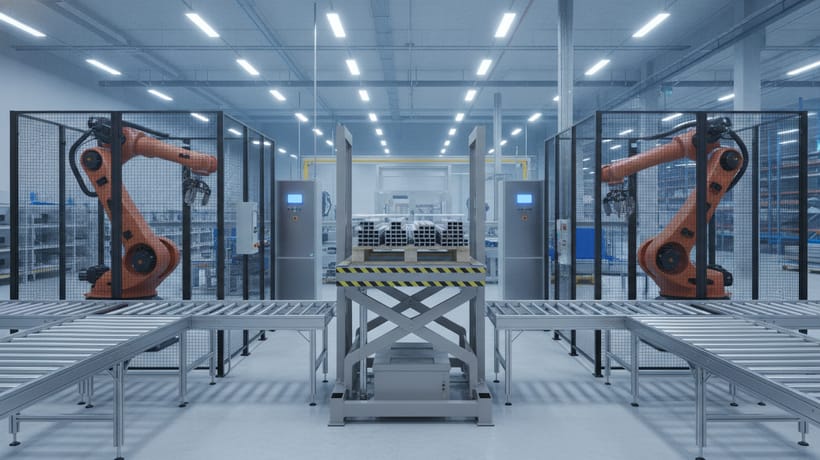
In a linked production system, different working heights meet: roller and chain conveyors run at different levels, processing stations have fixed transfer heights, and robotic cells expect the workpiece in a defined position. A lift table closes these gaps. As a height compensator it raises or lowers the load exactly to the level of the next conveyor, so that pallets and workpiece carriers move on without manual intervention. The platform often carries its own conveyor equipment for this, such as powered roller tracks that actively receive and release the load.
Lift tables also act as buffers and transfer stations. Where two process steps run at different speeds, a lift table decouples the sections: it takes on a load, holds it ready at a defined height and releases it as soon as the following station can receive it. In this way conveyor levels can be connected, changes of direction realised and line sections linked flexibly, without the whole system having to be planned on a single level.
Interfaces to the line control system
In an automated line, a lift table does not act on its own; it follows a higher-level control system, such as a PLC, which coordinates the material flow of the whole plant. Communication runs over defined signals: the line control issues movement commands, and the lift table reports back whether a stopping position has been reached, whether the end positions have been approached and whether a transfer can be released. From the plant's point of view, the lift table is an actuator with clear states that fits into the sequence logic of the line.
The basis for this is defined stopping positions. Sensors on the lift table detect when the platform has reached a stored height and stop the movement reproducibly at that point; limit switches safeguard the upper and lower end positions. How many stopping positions are needed, and in what form the signals are exchanged, follows from the plant concept. What matters is that the interface is fixed early in the project, so that the control system, the conveyor equipment and the lift table speak the same language.
Positioning accuracy and repeatability
With manual loading, a person corrects small deviations without thinking about it. An automated transfer cannot: when a roller track passes a pallet to the next level, or a handling device picks a workpiece, the transfer height must be the same in every cycle. Even a small offset can cause loads to jam, sensors to report a fault and the line to stop. What counts is therefore not only how precisely a lift table approaches a height once, but how reliably it hits it on every repetition.
This is where electromechanical drives show their strengths. Spindle lift tables position to within ±1 mm, at load capacities of up to 12,000 kg; even heavy loads can thus be brought to height reproducibly for automated transfers. The oil-free push-chain spindle drives from PETec follow a related approach: they lift evenly even when the load sits on one side of the platform. For line integration this means that the achievable accuracy depends on the drive technology and therefore belongs in the requirements profile early on.
Cycle rates and duty: sizing for continuous operation
An automated line does not work occasionally, it works in cycles: the lift table may approach its positions many times an hour, across shifts and on every operating day. For sizing, this is a topic in its own right, because the drive, the mechanics and the control system must be rated for the actual number of cycles and the duty cycle. A lift table dimensioned for occasional strokes is quickly overtaxed in continuous operation, even if load capacity and lift height look right on paper.
Specific limit values can only be set seriously case by case, because they depend on the load profile, the lift height, the speed and the ambient conditions. What matters is to quantify the expected cycle rate honestly: how many cycles per hour, how many operating hours per day, with what load? With this information the sizing can be clarified in a targeted way before equipment is ordered, rather than once an undersized unit shows up in operation.
Safety in the automated cell
The decisive standard for the safety of lift tables is EN 1570-1. Among its basic principles is protection against crushing and shearing points, which arise by design at the scissor mechanism: as the table lowers, the scissor arms close and the area beneath the platform becomes a danger zone. Safeguards such as contact edges running around the platform or covers address this risk at the machine itself, regardless of whether the lift table is operated manually or controlled automatically.
In an automated cell, the interaction with the plant is added. The lift table's emergency stop is integrated into the emergency-stop concept of the line, so that a stop at one point puts the whole cell into a safe state. Access protection such as guard fences, monitored doors or light curtains prevents people from entering the working area while the plant is running. Which combination of these measures is appropriate follows from the risk assessment of the whole cell, not from looking at the lift table alone.
From the idea to an integrated solution
Anyone planning line integration is best advised to clarify the essentials in this order: first the role of the lift table in the material flow, then the required stopping positions and accuracy, next the cycle rate and duty, and finally the safety concept of the cell. The result is a requirements profile with which a lift table can be selected purposefully and fitted into the plant, instead of being adapted afterwards.
An overview of lift tables designed for automated production lines and transfer systems is provided on our page Lift Tables for Automation and Manufacturing. And if you would like to discuss a specific integration project, you can reach us easily via our contact page.
Frequently asked questions about lift tables in automation
What are lift tables used for in automated production lines?
In automated lines, lift tables perform three tasks: they bridge height differences between conveyor levels, buffer loads between process steps running at different speeds, and serve as transfer stations that bring pallets or workpiece carriers to the working height of the next station. The platform often carries its own conveyor equipment for this, such as powered roller tracks.
How are lift tables connected to the higher-level line control system?
The connection runs over defined signals: the line control system issues movement commands, and the lift table reports reached stopping positions and end positions back and releases transfers. Sensors stop the platform reproducibly at stored heights, and limit switches safeguard the end positions. The specific design of the interface is fixed in the plant project.
Why does positioning accuracy matter for automated transfers?
Automated transfers cannot compensate for deviations: the transfer height must be the same in every cycle, otherwise loads jam or sensors report a fault. Repeatability is decisive. Spindle lift tables position to within ±1 mm at load capacities of up to 12,000 kg; the oil-free push-chain spindle drives from PETec also lift evenly, even under one-sided loading.
What part do duty cycle and cycle counts play in sizing for continuous operation?
In continuous operation, the drive, the mechanics and the control system must be rated for the actual number of cycles and the duty cycle. Specific limit values depend on the load profile, the lift height, the speed and the ambient conditions and must be clarified case by case. What matters is to quantify the expected cycle rate realistically before procurement.
Which safeguards are relevant in an automated lift table cell?
On the machine itself, the focus is on protection against crushing and shearing points at the scissor mechanism, which the standard EN 1570-1 makes a principle. In the cell, the integration of the emergency stop into the concept of the overall plant and access protection are added, such as guard fences, monitored doors or light curtains. The appropriate combination follows from the risk assessment of the whole cell.
Are you planning to integrate a lift table into an automated line and want to know which design suits your material flow? Our page Lift Tables for Automation and Manufacturing is the place to start.