When choosing a welding table, most people think of the plate first: hole pattern, flatness, clamping tools. Height matters just as much. A fixed welding table forces every person and every workpiece onto the same working height. A height-adjustable welding table brings the seam to where it is clearly visible and reachable without awkward postures. This guide explains what matters with a height-adjustable welding table: hole system, load capacity, drive, variants and welding trestles as a complement. The examples are PETec welding tables, which Tirugo supplies throughout Switzerland as authorised distributor.
What makes a good welding table?
A welding table is not an assembly table with a steel top. It is designed for clamping, fixing and joining and has to withstand heat, weld spatter and blows during straightening. The plate acts as a fixture: workpieces are aligned against stops, fixed with clamping elements and thus positioned repeatably. This leads to four criteria:
- Hole system: a continuous grid into which clamping and stop elements are inserted.
- Load capacity: sufficient for workpiece, fixture and load peaks.
- Height adjustment: robust, stepless and safe under load.
- Design: matched to the workpiece geometry, whether horizontal, tilting or rotating.
For pure assembly and inspection work, a height-adjustable assembly table with a smooth top is the better choice. Our guide Assembly tables for industry explains the distinction. The rule of thumb: joining and fixing points to the welding table, assembling and inspecting to the assembly table.
Hole system and Siegmund plate
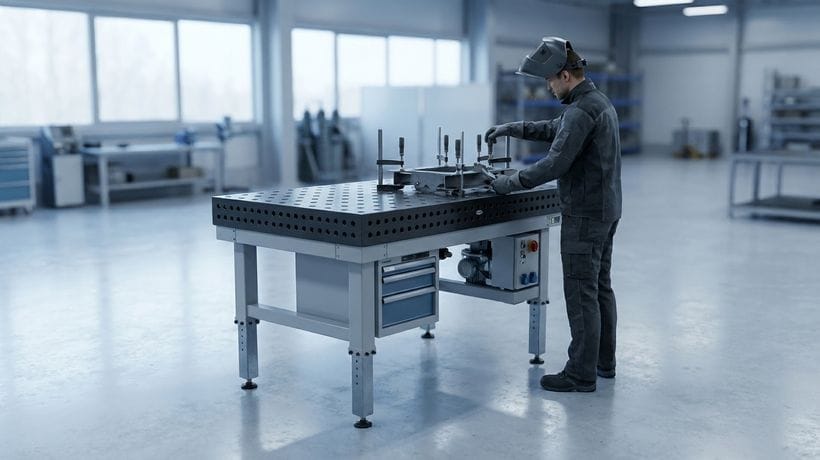
The core of the table is the welding plate with its hole grid. PETec welding tables use a Siegmund welding plate with a 16 mm hole system. The continuous grid accepts clamping, stop and angle elements and turns the plate into a flexible fixture: instead of building a dedicated jig for every part, the elements are inserted into the grid and clamped. Repeat parts can be positioned quickly and consistently, and for a new part the set-up is simply rearranged.
When choosing, it pays to look at what the workshop already has. Anyone who already owns clamping tools for a particular hole system should specify the new table for the same system so that accessories remain interchangeable between tables and trestles. For PETec welding trestles, Siegmund bridges are available in systems 16, 22 and 28.
Load capacity: workpiece, fixture and reserve
The load capacity of a welding table has to cover more than the weight of the workpiece. Clamping tools, stops and any fixture structures come on top, plus a reserve for impacts when setting down and straightening. Planning at the upper limit today keeps you flexible when heavier assemblies arrive on the table tomorrow.
Depending on the version, PETec height-adjustable welding tables carry up to 5,000 kg. For combined assembly and welding work with all-round access there is also the PETec Professional with a 360° swivelling, impact-resistant work surface, up to 1,500 kg in the electric version. All models and load capacities are compared in our overview of PETec tables.
Drive without hydraulics
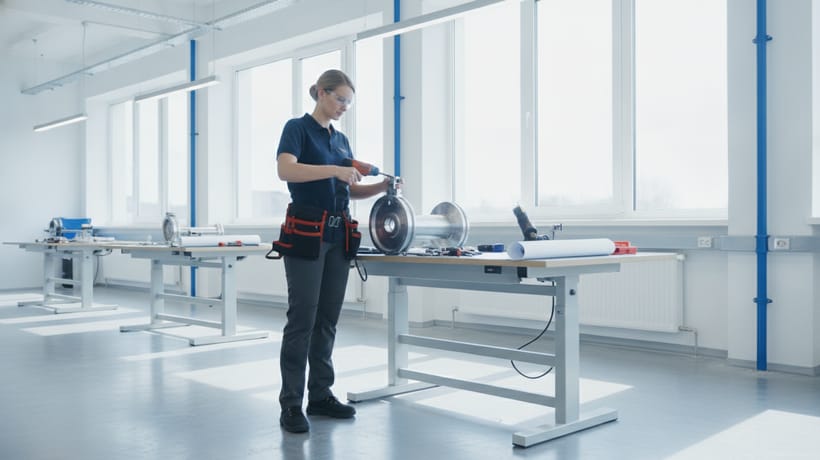
PETec adjusts its welding tables with a patented spindle-chain drive. A chain transmits the movement evenly to the spindles, so the plate moves synchronously and steplessly. The drive is self-locking: the set height stays in place even under load. Depending on the version, it is operated for example by cordless screwdriver. The cordless screwdriver version needs no fixed power connection at the table, which is practical at changing locations in the workshop.
As there are no hydraulics, there is no hydraulic oil and no hoses at the welding station that would be exposed to heat or spatter, and no risk of leaks. In an environment with flying sparks, this is an argument that goes beyond comfort.
Variants: tilting, 3D and welding lift table
Not every workpiece can be welded well on a horizontal plate. That is why PETec welding tables come in several variants:
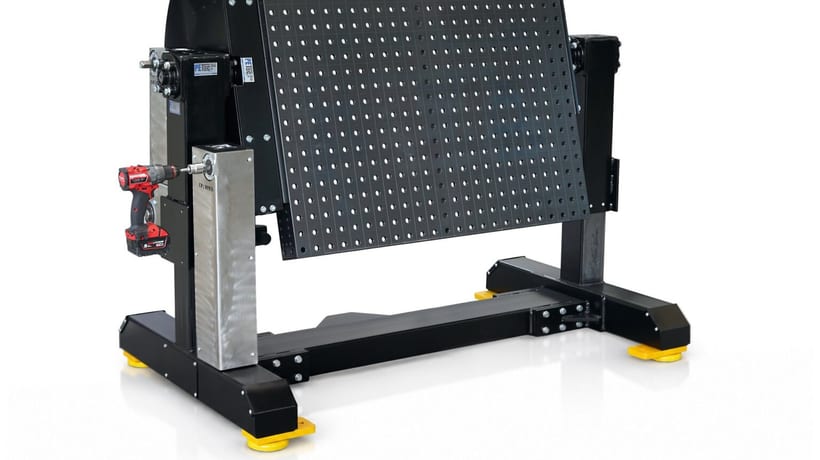
- Tilting: the plate can be inclined. The seam is brought into a favourable welding position instead of the welder contorting around the workpiece.
- 3D welding table: the plate rotates through 360°. Seams on all sides are reached by rotating, without re-clamping the workpiece.
- Welding lift table: a further design in the PETec range. We work out together with you which version suits your workpiece, space and process.
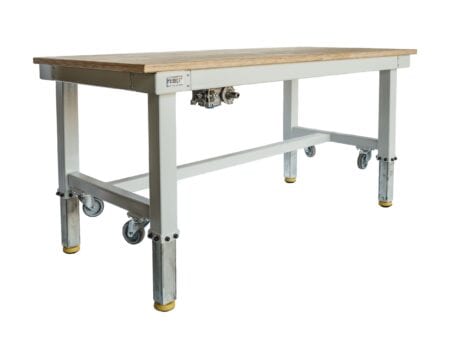
All variants are made to measure, Made in Germany. Castors are available as an option if the table is to move between different workstations.
Welding trestles as a complement to the welding table
Long or bulky workpieces such as frames, beams or tubes rarely fit entirely on one table. This is where height-adjustable welding trestles complement the welding table. Set to the height of the table top, they support protruding parts so that the workpiece lies flat and does not sag during welding.
PETec welding trestles carry up to 2,000 kg and can be adjusted within a range of approx. 750–1100 mm. They are designed for Siegmund bridges of systems 16, 22 and 28. For clamping and support tasks, PETec also offers the ProFlex trestles: a work trestle up to 1,000 kg, the «Extreme» support trestle up to 2,000 kg and a mobile clamping trestle with an adjustment range of 650–1000 mm and 16 mm holes.
Ergonomics when welding
Welding requires precision and a clear view of the weld pool, often in the same posture for long periods. If the seam is too low, you work bent over. If it is too high, the shoulders are held up in the air. Both strain the back, neck and shoulders and come at the expense of weld quality.
A height-adjustable welding table adapts the height to the person, the workpiece and the work step: lower when tacking large parts, higher for fine seams. As a standards-based guideline for standing work, DIN EN ISO 14738 gives around 95–115 cm depending on the task. When welding, what counts is the position of the seam, not the top of the plate: a tall workpiece needs a lower plate. If several people use the same station, each can reset the height in a short time.
Lifting is the other factor. Heaving heavy parts onto the table is one of the typical strains in metalworking and steel construction. Which guideline values SUVA specifies for lifting and carrying, and why technical measures take priority, is explained in our guide Preventing musculoskeletal disorders in the workplace.
Buying a welding table in Switzerland
Tirugo is the authorised PETec distributor and delivers throughout Switzerland. For selected PETec models, delivery starts from 7 days. For made-to-measure versions, we confirm the date with the quotation. Our demonstration models are currently being tested by customers; on request, we are happy to check whether we can provide you with a test model.
Before quoting, we clarify the key data with you: workpiece weight including fixture, required height range, plate dimensions, hole system, drive and variant. More about the manufacturer and all product lines can be found in the article PETec ergonomic tables: now available in Switzerland.
Frequently asked questions about height-adjustable welding tables
What load capacity does a PETec height-adjustable welding table have?
Depending on the version, PETec height-adjustable welding tables carry up to 5,000 kg. What counts for the selection is the weight of the workpiece, clamping tools and fixtures plus a reserve for impacts when setting down and straightening.
Which hole system do PETec welding tables use?
They use a Siegmund welding plate with a 16 mm hole system. The grid accepts clamping, stop and angle elements. PETec welding trestles are designed for Siegmund bridges of systems 16, 22 and 28.
Why choose a welding table without hydraulics?
PETec's patented spindle-chain drive works without hydraulic oil or hoses. This eliminates the risk of leaks, and the height is adjusted steplessly and self-locking, depending on the version for example by cordless screwdriver.
What is the difference between a welding table and a welding trestle?
The welding table is the main work surface with a perforated plate for clamping and fixing. A welding trestle supports long or bulky workpieces that extend beyond the table. PETec welding trestles carry up to 2,000 kg and can be adjusted within a range of approx. 750 to 1100 mm.
How quickly can a welding table be delivered?
For selected PETec models, delivery starts from 7 days. As many welding tables are made to measure, we confirm the binding delivery date with the quotation.
Are you planning a new welding station or want to replace a fixed welding table? We clarify workpiece, hole system and height range with you and put together the right PETec welding table. Submit your enquiry.