Lifting, carrying, working bent over: in production, logistics and assembly, physical work is part of everyday life. Carried out for years in an unfavourable posture or with loads that are too heavy, it adds up to musculoskeletal strain that affects employees and businesses alike. The good news: prevention can be planned. This article shows which reference values SUVA gives for lifting and carrying, what the SECO guidance on Ordinance 3 to the Employment Act requires of the employer, why technical measures take precedence and how height-adjustable workstations reduce the strain in daily work. It closes with a practical way in: the risk assessment.
What are musculoskeletal disorders and why are they costly?
Musculoskeletal disorders affect the locomotor system: muscles, tendons, ligaments, joints and the spine. They rarely result from a single event. What is typical is the gradual accumulation over months and years: heavy or frequent lifting and carrying, working in a stooped or twisted posture, tasks above shoulder height, standing for long periods in the same position, or constantly repeated movements. The back is particularly exposed, but shoulders, neck, elbows, hands and knees can also be affected. Whether a task causes harm in the long run depends on the interplay of load weight, posture, frequency and duration.
For businesses, these complaints are costly for two reasons. First, they lead to absences and restrictions that are hard to absorb, especially in small teams. Second, prevention is not an optional extra but part of the employer's duties: to protect the health of employees, all measures must be taken that experience has shown to be necessary, that the state of the art allows and that are appropriate to the circumstances of the business. Providing ergonomically designed workstations therefore not only fulfils a duty but also protects the company's own capacity to perform.
The Swiss framework: SUVA reference values and the SECO guidance
How much weight is reasonable? Guidance comes from SUVA publication 88190 on assessing physical strain when lifting and carrying loads. As reference values for occasional lifting, it gives 25 kg for men and 15 kg for women. The second threshold is the important one: where lifting occurs more than four times per hour, an assessment of the strain is required from as little as 12 kg for men and 7 kg for women. The reference values are not thresholds below which anything goes, but triggers for a closer look at the task. In addition, the SUVA leaflet on correct lifting technique (44018) sets out the principles of sound lifting.
The second pillar is the Employment Act with its Ordinance 3 (ArGV 3), which governs health protection. The associated SECO guidance states in relation to Art. 25 that the employer must provide suitable work equipment for moving loads. The direction is clear: strenuous manual handling should not be left to chance or to individual strength, but defused with suitable equipment. Assess in line with the SUVA reference values, equip in line with the SECO guidance: that is the Swiss framework in a single sentence.
The hierarchy of measures: technical before organisational
Once strenuous tasks have been identified, the question is the right order of measures. For handling heavy loads, SUVA describes a clear hierarchy: first, examine whether the strain can be avoided or reduced at source, for example through smaller containers or changed processes. Technical measures come next, meaning the provision of suitable aids by the employer. Only when these options are exhausted do organisational measures such as rotation or additional breaks follow, and finally behavioural measures such as training in lifting technique.
The reason is plain: technical measures work permanently, regardless of whether every rule is followed on a hectic day. A workstation that adapts to the person and the task protects in every shift, even under time pressure. Organisational and behavioural measures remain important, but they complement the technical solution rather than replace it. In this logic, height-adjustable workstations are a technical measure in the best sense: they remove the cause of the poor posture instead of merely softening its effects.
Working height and posture: ergonomics in practice
The right working height is not a fixed number but depends on the task. As a rule of thumb: fine work with high visual demands sits higher, so that the workpiece is close to the eyes. Light assembly work sits at about elbow height. Work requiring force sits lower, so that body weight can help. Requirements for working heights and body dimensions at machine workstations are set out in the standard DIN EN ISO 14738. A fixed table can never cover this span for everyone: what suits a tall person forces a shorter one to work with raised shoulders, and vice versa.
Constrained postures are the second big lever. Working stooped, twisted or overstretched loads the spine even without a heavy load, and static holding tires the muscles faster than dynamic movement. The goal of ergonomic design is therefore that the work comes to an upright, relaxed posture rather than the person going to the work. Variation is part of this: anyone who can adjust the height to changing work steps over the day spreads the strain across different muscle groups instead of fixing a single posture for hours.
Height-adjustable workstations and positioning equipment in operation
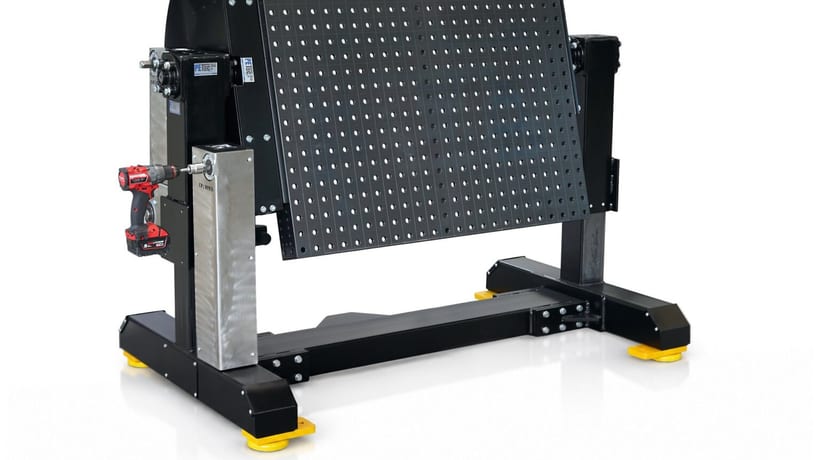
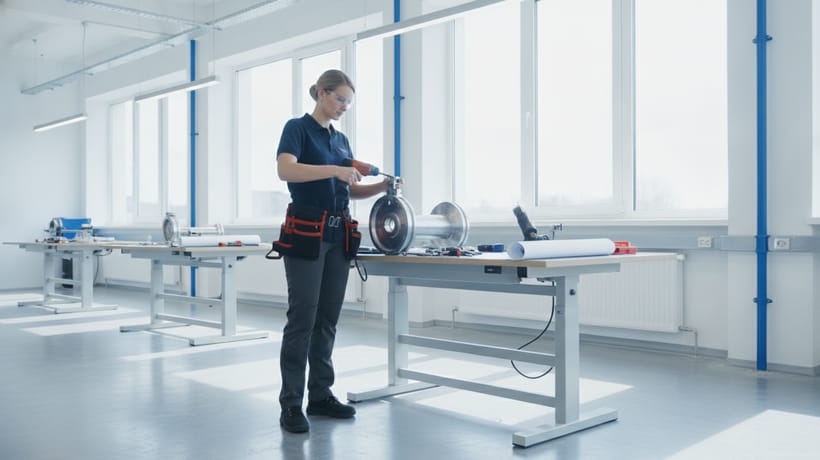
In practice this means: the workstation adjusts to the person and the workpiece. A height-adjustable work table brings every component to the individually right height, whether for joining, inspecting, packing or welding. At shift change, the next person resets the height in seconds, and the same workstation remains ergonomic for different body heights. Ergonomic work tables from PETec are continuously height-adjustable and designed for loads from 100 to 2,000 kg, with some lines carrying even more. Even heavy assemblies can thus be positioned at working height without anyone having to work bent over.
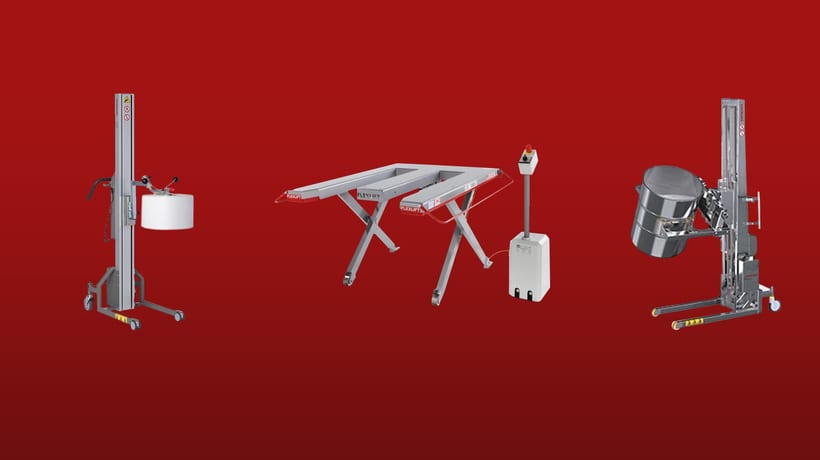
The second building block concerns the load's path to the workstation. Where containers, boxes or components are regularly lifted and moved by hand, mobile mini lifts take over the raising and positioning, so that the reference values for lifting and carrying are not even approached. Together this creates a consistent principle: the load arrives at the right height before people handle it, and stays there during the work. It is precisely this combination of adjustable workstation and supported load positioning that reduces musculoskeletal strain where it arises.
Putting prevention into practice: the risk assessment as the starting point
The way into prevention is unspectacular, and effective precisely for that reason: a risk assessment of physical strain. First record the tasks that involve lifting, carrying, pushing or working in an unfavourable posture. Note load weights, frequencies and postures, and compare the results with the SUVA reference values: wherever loads of 12 kg or more for men, or 7 kg or more for women, are lifted more than four times per hour, a more detailed assessment is required. Involve your employees: they know best which movements really take their toll.
From the assessment, the measures follow in the order described: avoid, relieve technically, organise, train, and then review the effect. It often turns out that a few well-equipped workstations remove a large share of the strain. We are happy to support you in choosing the right technical solution: Tirugo advises across Switzerland on height-adjustable workstations and positioning equipment, from analysing the task to the right configuration.
Frequently asked questions about musculoskeletal strain in the workplace
From what load weight must physical strain be assessed according to SUVA?
According to SUVA publication 88190 on assessing physical strain when lifting and carrying loads, an assessment is required when men lift loads of 12 kg or more, or women lift loads of 7 kg or more, more than four times per hour. The assessment forms the basis for targeted measures.
Which reference values apply to occasional lifting and carrying in Switzerland?
As reference values for occasional lifting, SUVA publication 88190 gives 25 kg for men and 15 kg for women. These are reference values, not thresholds below which anything goes: where lifting occurs more than four times per hour, an assessment of the strain is required from 12 kg and 7 kg respectively.
Is the employer obliged to provide technical aids?
Yes. The SECO guidance on Ordinance 3 to the Employment Act states in relation to Art. 25 that the employer must provide suitable work equipment for moving loads. SUVA likewise calls for suitable aids to be provided when handling heavy loads, with technical measures taking precedence over organisational ones. Height-adjustable workstations and positioning equipment are such technical measures.
How does a height-adjustable workstation help against musculoskeletal strain?
It brings the work to the right height instead of forcing the person to adapt to the work. Stooped working, tasks above shoulder height and static constrained postures are reduced, and several people can use the same workstation ergonomically. Ergonomic work tables from PETec are continuously height-adjustable and designed for loads from 100 to 2,000 kg.
What does the SECO guidance on ArGV 3 require with regard to ergonomics?
The SECO guidance gives concrete form to Ordinance 3 to the Employment Act, which governs health protection in the workplace. In relation to Art. 25 it states that suitable work equipment must be provided for moving loads. Workplaces and processes must therefore be designed so that strenuous manual handling is avoided as far as possible or eased with suitable equipment.
Would you like to design workstations in your business that are easy on the back and joints, and are you looking for the right technical solution? We advise you without obligation and across Switzerland. Get in touch with us.