Between goods-in and dispatch lies the area where most material actually moves in many businesses: intralogistics. Goods are put away, picked, staged at workstations and palletised again, and with almost every one of these steps the load changes height. This is exactly where lift tables come in: they bring pallets, containers and parts to the height at which people work ergonomically and processes mesh cleanly. This article presents the most important in-plant applications, from order picking and line-side material supply to pallet handling, and explains what matters when it comes to platform format, load capacity and accessibility.
Intralogistics: lift tables as the in-plant link
Intralogistics covers all material flows within a site: from the warehouse into production, from production to packing, and between individual workstations and levels. Different heights meet constantly: conveyor systems transfer at a fixed level, racking starts at the floor, workstations are laid out at elbow height, and industrial trucks set their loads down close to the ground. A lift table evens out these differences. As a stationary link, it picks a load up at one level and presents it at another, repeatably and without muscle power.
One distinction matters: this article is about handling inside the building; loading lorries at the ramp is a separate topic with its own requirements and is deliberately left aside here. In-plant, other things count than at the ramp: constant working heights, short distances and cycle times, ergonomic gripping zones and smooth transfer between people, machines and industrial trucks. The following sections show how lift tables take on these tasks in picking, staging and palletising.
Order picking at an ergonomic height
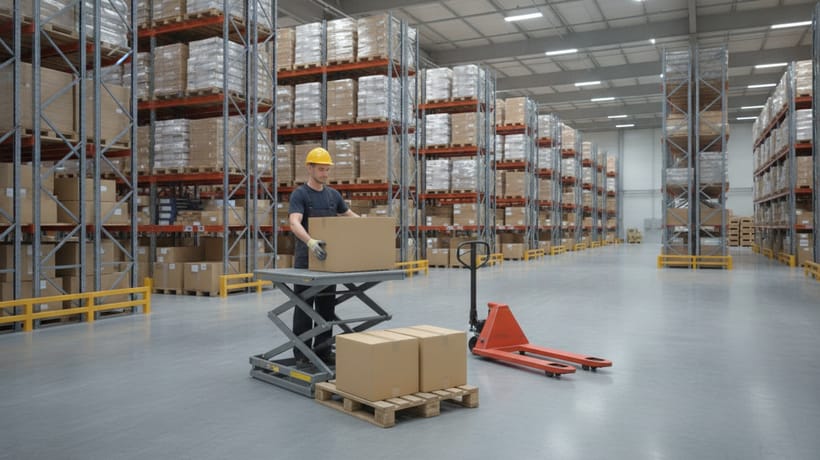
In order picking, employees take individual articles or packs from a pallet or container and assemble orders from them. Without an aid, that means: the top layer starts above shoulder height, and the bottom layer ends up just above the floor. Every pick then forces the picker to stretch or bend. A lift table solves this problem in a simple way: the pallet stands on the platform, and with every portion of the load that is worked through, it is raised a little. The removal level thus stays at a favourable gripping height throughout.
The effect shows twice over. Ergonomically, the constant gripping height relieves the back and shoulders, because deep bending and working above head height are eliminated. On the process side, employees work more evenly, because every reach takes place in the same zone and no time is lost on compensating movements. Especially at workstations where picking goes on for hours, this difference adds up noticeably. Whether the table is adjusted step by step or moved to fixed positions depends on the workflow.
Material supply at the line
At assembly and production lines, the quality of material supply decides how smoothly the actual value creation runs. Parts, containers and pallets must stand where they are needed, and at the height at which they are gripped. A lift table at the edge of the line keeps the load constantly at removal height: the operator takes parts from the top layer, and the table adjusts the pallet accordingly, without interrupting the working rhythm.
The supply itself also becomes easier. Replenishment can be delivered as a whole pallet or in a container and set down directly on the lift table; from there it is ready at working height without repacking. This cuts out intermediate steps, avoids lifting heavy packs by hand and creates defined transfer points at the line where logistics and production mesh cleanly.
Ergonomic pallet handling: pallet changes and layer building
The counterpart to order picking is palletising: cartons or packs are built up layer by layer on a pallet or taken off it. The principle of the constant working height applies here too, only in the opposite direction. When palletising, the lift table lowers a little with every completed layer, so the current layer is always built at the same height. When depalletising, it raises the pallet accordingly. The pallet change itself also becomes easier, because empty and full pallets are taken over at a defined height.
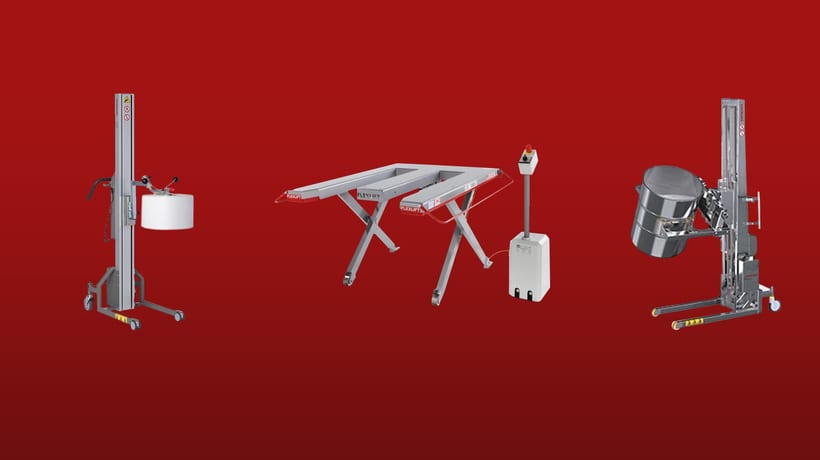
For handling Euro pallets, Flexlift offers a solution tailored precisely to this with the FE series: the standard platform of 910 mm is matched to the format of the Euro pallet, and the E-shaped platform supports all three runners of the pallet. Load capacities range from 300 to 2000 kg, covering the common cases from light carton handling to heavy loads. Particularly pleasant in practice: the underside of the pallet can be brought to a working height of around 900 mm, in other words to the level at which layers can be built and removed comfortably.
Applications at floor level: hand pallet trucks and roll containers
For a lift table to fit into the in-plant flow, it must be accessible to industrial trucks. On the Flexlift FE series, the E-shape of the platform takes care of this: its cut-out is designed so that a hand pallet truck can drive the pallet straight in and set it down at floor level. No forklift is needed for this, and ramps or pits are dispensed with. The FE belongs to the family of flat-form lift tables, which can be installed flush with the floor with build heights from 55 mm; the product page shows the details of this design.
Not every load stands on a pallet. In many businesses, roll cages and logistics trolleys move through the building, for example in small-parts supply or in-plant transfer. For these cases, PETec offers the electric roll container lift, a mobile lifting system for roll cages and logistics trolleys. This brings the principle of a favourable working height to places where rolling containers rather than pallets shape the material flow.
Finding the right lift table for your intralogistics
Which lift table is the right one follows from a few core questions: Which loads are moved, and what load capacity must the platform take? What format do the pallets or containers have, and is a platform matched to Euro pallets needed? How is the table loaded, with a hand pallet truck at floor level or with a forklift? And at which heights is work done, from the transfer to the conveyor system to the gripping zone of the employees? Answering these points narrows the selection down quickly.
An overview of suitable equipment for warehousing and order picking, from pallet handling to integration into existing processes, is provided on our page lift tables for logistics and warehousing. Tirugo supports you in making the selection throughout Switzerland: from analysing the application and configuring the equipment to commissioning, with Flexlift and PETec equipment made in Germany.
Frequently asked questions about lift tables in intralogistics
What are lift tables used for in intralogistics?
Lift tables link in-plant processes in which loads change height: in order picking they keep pallets at gripping height, at assembly and production lines they present parts and containers at a constant removal height, in palletising and depalletising they maintain a steady working height, and between conveyor systems, workstations and industrial trucks they even out differences in level.
How do lift tables improve ergonomics in order picking?
They keep the removal level constantly at a favourable gripping height. As a pallet is worked through, the lift table raises it step by step, so the current top layer always sits in the same zone. Deep bending and working above shoulder height are eliminated, the working posture stays even, and the strain on the back and shoulders is reduced.
Which platform format is suitable for Euro pallets?
For Euro pallets, Flexlift offers the FE series with a standard platform of 910 mm. The E-shaped platform supports all three runners of the pallet, load capacities range from 300 to 2000 kg, and the underside of the pallet can be brought to a working height of around 900 mm. The cut-out of the E-shape also allows a hand pallet truck to drive in at floor level.
What is the difference between in-plant handling and loading?
In-plant handling covers all material flows inside the building, such as picking, staging and palletising; there, constant working heights and ergonomics are the priorities. Loading concerns the transfer of goods to lorries at the ramp and places its own demands on equipment and safety; it is therefore a separate topic and not the subject of this article.
How do floor-level lift tables support the use of hand pallet trucks?
A hand pallet truck can only set a pallet down close to the ground. Floor-level solutions address exactly this point: on the Flexlift FE series, the hand pallet truck drives straight into the platform at floor level thanks to the E-shape cut-out, and flat-form lift tables can be installed flush with the floor with build heights from 55 mm. The pallet is transferred without a forklift, ramp or pit.
Would you like to make order picking, staging or pallet handling in your warehouse more ergonomic? We advise you throughout Switzerland on suitable equipment for your application. Get in touch and we will come back to you promptly.