The nameplate of a lift table shows one figure: the rated load. Selecting a table on this figure alone risks a wrong specification, because the rated load applies to one precisely defined ideal case. As soon as a load is placed concentrated, on one side or with a shifted centre of gravity, different limits apply. This article explains what the lifting table load capacity really means, how to read the load distribution rules of EN 1570-1, why the load centre of gravity decides the permissible load, and what information a supplier needs when sizing a scissor lift table.
Understanding the rated load: what the nameplate figure really means
The rated load is the load the lift table is designed for when it rests evenly distributed across the entire platform. A lift table with a rated load of 1,000 kg therefore carries 1,000 kg, provided that this weight is spread over the whole platform surface. Exactly this load case underlies the nameplate figure. It corresponds, for example, to an evenly loaded pallet that largely fills the platform.
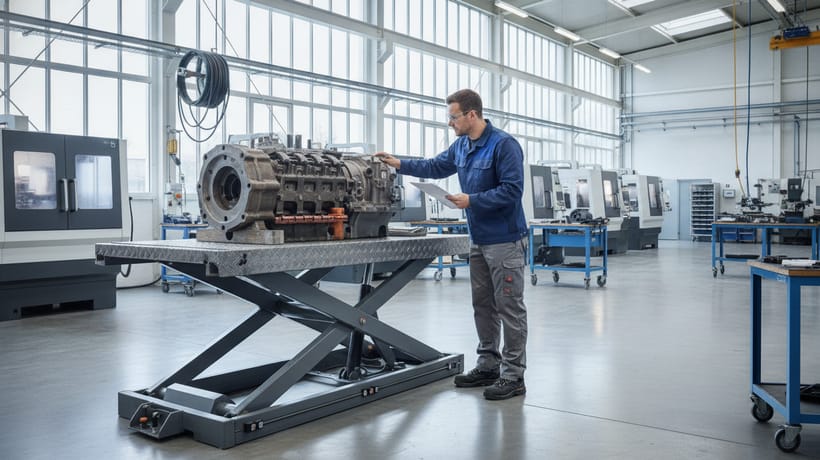
In practice, loading often looks different: a compact machine part in the middle, a half-loaded pallet at the edge of the platform, a container occupying only part of the surface. In such cases the rated load alone does not tell you whether the lift table carries the load safely. What matters then is how the weight is distributed on the platform and where its centre of gravity lies. Anyone who overlooks this may be operating a lift table outside its design envelope, even though the total weight stays below the rated load.
Load distribution under EN 1570: the one-third rule
The European safety standard EN 1570-1 bases the design of lift tables on defined load cases. Three of them form the basic principle of load distribution: first, the lift table must carry the full rated load when it is evenly distributed across the entire platform. Second, it must carry 50 percent of the rated load when this rests on half the platform length. Third, it must carry one third of the rated load when this rests on half the platform width. This graduation is often referred to as the one-third rule.
The direction of reading matters: the rule is a design principle, not a licence for arbitrary loading. It describes which uneven load cases a lift table designed to the standard must at least master. For practice this means, conversely: anyone setting a load down on only one half of the platform must not reckon with the full rated load, but only with the corresponding share. The specific values for a particular model are stated in the manufacturer's documentation; in case of doubt, the manufacturer's specification applies.
Off-centre loads and the load centre of gravity
An off-centre load arises whenever the load centre of gravity does not sit over the middle of the platform. This loads the scissor mechanism, the bearings and the drive unevenly: one side carries more, the rollers run under higher load, and the platform can deflect more strongly. A shifted centre of gravity therefore reduces the permissible load compared with the rated load. The further the centre of gravity moves towards the edge, the smaller the reserve becomes.
This is particularly relevant in order picking and palletising. There, a pallet is built up or broken down layer by layer, and the centre of gravity moves constantly: sometimes the weight sits at the front, sometimes on one side, sometimes on a single corner. A lift table taking on such tasks must be sized for them. The drive concept also plays a part: the push-chain spindle drive of the PETec tables, for example, lifts evenly even under one-sided loading. Such characteristics do not replace correct sizing, but they show that the design and the drive must match the real loading.
Platform size, pallet format and support
Besides load and centre of gravity, the platform decides the right choice. It must match the load: if the load overhangs, the centre of gravity quickly shifts outwards; if the platform is much larger than necessary, the space requirement grows. A proven reference point is the pallet format. The flat-form lift tables of the Flexlift FE series are available with load capacity steps from 300 to 2,000 kg and carry as standard a 910 mm platform matched to Euro pallets.
With flat E-shaped platforms, the support comes into play: the E-shape is designed so that it supports all three skids of a Euro pallet. The pallet thus rests solidly instead of balancing on two skids only, and the weight is introduced evenly. Such details look inconspicuous, but they decide whether the calculated load capacity can also be used safely in practice. Anyone working with other load carriers, such as mesh boxes or special pallets, should therefore examine the support situation just as closely as the weight.
Dynamic factors: duty cycle and lifting cycles
The load capacity describes a static quantity. In operation, dynamics come into play: how often does the lift table raise and lower per hour? How many hours a day does it run? Is it used in single-shift or multi-shift operation? These factors determine how heavily the drive, the hydraulics and the mechanical components are stressed. A lift table that raises a load a few times a day is loaded differently from a unit working in the cycle of a production line.
Specific limits for duty cycle and the number of cycles depend on the model, the drive and the installation situation, and therefore need to be clarified with the supplier in each individual case. What matters is to describe the use honestly: a realistic statement of the lifting cycles per hour and the daily operating time belongs in every enquiry. This avoids a unit sized for occasional lifts wearing out prematurely in continuous use.
From sizing to enquiry: what your supplier needs to know
A sound sizing starts with complete information. The more precise the enquiry, the better the offer fits. This checklist has proven itself:
- Load: weight of the heaviest load, type of load (pallet, container, machine part) and its dimensions.
- Load distribution: position of the load centre of gravity, any loading that is off-centre by design, and the type of loading (forklift, pallet truck, crane, by hand).
- Platform: desired dimensions, load carrier and support situation, required features such as stops or ramps.
- Lift: lowest and highest position, lowered height and the available installation space or pit.
- Environment: indoor or outdoor use, temperature and ambient conditions, plus the planned use with lifting cycles per hour and operating time per day.
From this information a supplier derives the design, load capacity, platform and drive. Special requirements also become visible early: where positioning to the millimetre is required, spindle lift tables come into consideration; the SFL spindle lift tables position to within ±1 mm at load capacities of up to 12,000 kg. If you are unsure which details your application requires, we support you across Switzerland with the sizing: get in touch via our contact page and describe your application.
Frequently asked questions about sizing a lift table
What does the rated load of a lift table mean?
The rated load is the load a lift table is designed to carry when it rests evenly distributed across the entire platform. It does not automatically apply to concentrated, one-sided or shifted loads. If the weight is concentrated on part of the platform, the permissible load is reduced in line with the load distribution rules of EN 1570-1.
How does an off-centre load affect the permissible load capacity?
If the load centre of gravity is not over the middle of the platform, the scissor mechanism, bearings and drive are loaded unevenly. The permissible load is therefore lower than the rated load. As a design principle under EN 1570-1, 50 percent of the rated load is permissible on half the platform length and one third on half the platform width. For loads that are off-centre by design, the sizing should be clarified with the supplier.
What does the one-third rule of load distribution under EN 1570 say?
The standard bases the design on three load cases: the full rated load evenly distributed across the whole platform, 50 percent of the rated load on half the platform length, and one third of the rated load on half the platform width. A lift table must carry these cases safely. Anyone placing a load concentrated or on one side must therefore reckon with considerably less than the rated load.
What information does the manufacturer need for correct sizing?
A safe sizing requires the load weight with its centre of gravity, the type of loading and load handling, the dimensions of the load and the desired platform, the required lift with the installation height, and the operating environment. The frequency of lifting cycles and the daily operating time also belong in the enquiry, because they influence the design of the drive and components.
Is the rated load sufficient as the only criterion for selection?
No. The rated load only describes the ideal case of a load distributed across the full platform. Equally important for the selection are load distribution and centre of gravity, platform size, lift, type of loading and operating conditions. Two lift tables with the same rated load can be suited to a task very differently in practice.
Are you planning a new lift table and want to define load capacity, platform and drive correctly from the start? We support you across Switzerland, from the first enquiry to the finished specification. Request your sizing consultation.