A lift table that has run reliably for many years need not be at the end of its life. Often the load-bearing structure is intact while the control system, the guards or individual wear parts are outdated. This raises the question: modernise or buy new? This article sets out when a retrofit is worthwhile, which upgrades are possible and where the legal line to a substantial modification runs. It also explains what the new EU Machinery Regulation means for buyers and operators in Switzerland from 20 January 2027. We deliberately do not quote prices here, because they depend heavily on the condition and on the scope of the work.
Modernise or buy new? The starting question
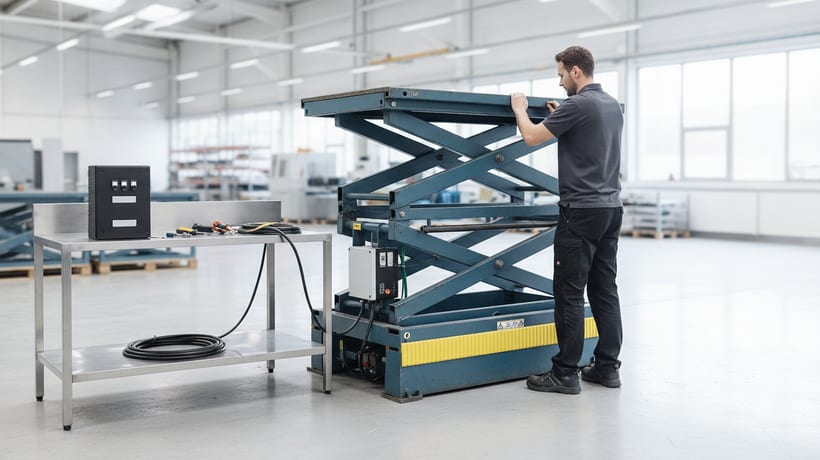
It begins with a sober stocktake. Four points are decisive: the structural condition, the age and operating hours, the availability of spare parts, and the safety level compared with today's state of the art. If the base structure, meaning the scissor assembly, platform and frame, is sound and free of relevant cracks or deformation, much speaks for a retrofit. If, on the other hand, load-bearing parts are worn out or key components are no longer available, buying new can be the more economical and safe solution.
A retrofit plays to its strengths above all when a lift table is technically sound but no longer sufficient in detail: a control system without up-to-date safety functions, a missing toe guard, or a drive that still runs but no longer suits a changed task. Instead of replacing the whole unit, the critical assemblies are renewed in a targeted way. This conserves resources and preserves an established piece of equipment that is integrated into the process.
What a lift table retrofit involves
Modernisation covers a whole range of measures, from a small safety upgrade to a comprehensive conversion. In practice, the most common retrofits are these:
- Retrofitting a toe guard: A guard strip or guarding device running around the scissor mechanism prevents crushing and shearing points in the lowering area. On older equipment in particular, this is one of the most effective improvements.
- Retrofitting the control system: A new control system replaces worn switchgear, provides defined stopping positions and creates the basis for up-to-date safety functions. Where the process requires it, the equipment can be tied into production via a control interface.
- Adding safety technology: Guards, emergency-stop functions and further measures bring older equipment up to a current safety standard.
- Repairing hydraulics, electrics and mechanics: Repairs to hydraulics, electrics, mechanics and control technology remedy wear and restore the safe operating condition, independently of the manufacturer and also on third-party makes.
- Sourcing spare parts: Original Flexlift spare parts and compatible parts for common lift table makes keep a unit available across its life cycle.
Which of these building blocks make sense follows from the condition assessment. Not every lift table needs the full programme; often a few targeted interventions are enough to improve safety and availability considerably.
When a modernisation becomes a substantial modification
Here begins the legally delicate part, and it deserves attention before a conversion starts. The Swiss legal framework for operating work equipment rests on the Federal Accident Insurance Act (UVG), the Ordinance on the Prevention of Accidents and Occupational Diseases (VUV) and EKAS Guideline 6512. The foundations of this framework, from the operator obligations to documentation, are explained in our article Lift Table Inspection in Switzerland. Here the focus is on a different aspect: the consequences of a change.
The decisive provision is Art. 32a para. 4 VUV. Under it, where work equipment is substantially modified, or used other than as intended by the manufacturer, the newly arising hazards must be reduced so that the safety and health of employees are ensured. The EKAS guidance on Guideline 6512 names as typical examples of a substantial modification an increase in performance, a change in function or a change in the intended use. Whether a change is substantial is decided by a risk assessment in each case: it clarifies whether the conversion has created a new hazard or has substantially increased an existing risk. If so, the measures must be taken as if it were a new machine.
This classification has an important consequence. Anyone who changes the essential characteristics of a machine can legally become the manufacturer. In that case, a renewed conformity assessment with risk assessment, a new declaration of conformity, a new CE marking and revised technical documentation and operating instructions may become necessary. Conversely, where a retrofit maintains or improves an existing safety level without creating new hazards, there is usually no substantial modification. This is precisely why it makes sense to plan a safety upgrade such as a toe guard carefully. SUVA provides orientation for this approach and recommends calling in external specialists where in-house expertise is lacking. As a rule of thumb: examine the question of substantial modification before the conversion, not afterwards.
The EU Machinery Regulation 2023/1230 from 20 January 2027
Above this topic stands an upcoming legal change that concerns everyone who procures or modifies machinery. Regulation (EU) 2023/1230 on machinery applies from 20 January 2027 and replaces the previous Machinery Directive 2006/42/EC. Unlike the old directive, which had to be transposed into national law by the member states, the new instrument is a regulation: it applies directly in the EU, with no national transposition step, and there is no transition period. Machinery placed on the market from 20 January 2027 must meet the new requirements; for placing on the market up to 19 January 2027, the Machinery Directive 2006/42/EC remains decisive.
For the topic of modernisation, one point is especially relevant: the new regulation defines the concept of substantial modification in binding EU law for the first time (Art. 3 no. 16). It means a physical or digital change to a machine, not foreseen or planned by the manufacturer, made after it was placed on the market or put into service, that impairs safety by creating a new hazard or increasing an existing risk. A concept that was previously interpreted mainly through guidance documents and interpretation papers is thus placed on a clear statutory footing. For operators who convert equipment, this brings more clarity, but also more binding force.
And Switzerland? It is not an EU member, but it is closely interlinked with EU machinery law through the bilateral Mutual Recognition Agreement (MRA) on conformity assessment. Switzerland is aiming for equivalent implementation in order to preserve market access. To this end, SECO is preparing the revision of the Swiss Machinery Ordinance to align it with the new EU regulation, with the aim of bringing it into force in good time before 20 January 2027. In practice this means: anyone procuring or modernising today is well advised to keep the new regulation in mind already, so that equipment stands on a sound conformity footing even after the cut-off date.
Maintenance backlog, spare parts and service life
Besides safety and law, modernisation has a tangible economic side. Deferred maintenance adds up over time to a maintenance backlog that raises the likelihood of failure and, at the worst moment, leads to a standstill. Certain manufacturer maintenance requirements are not negotiable here. For Flexlift lift tables, for example, all hydraulic hoses must be inspected annually and replaced after six years at the latest, even if no damage is visible from the outside; in multi-shift operation the maintenance intervals are halved. This limit is in line with the standard DIN 20066, which recommends a service life of no more than six years for hydraulic hose lines.
A retrofit is the right moment to clear such a maintenance backlog: wear parts are replaced, the documentation is brought up to date, and the equipment starts the next stage of its life with a defined baseline condition. Because maintenance follows the manufacturer's instructions, and these are binding under Art. 32b VUV, it is worth honestly assessing the condition of all maintenance-relevant assemblies on this occasion. The availability of spare parts is a central argument here: as long as original or compatible parts can be sourced, modernisation remains a realistic option. If they are missing, the balance shifts towards buying new.
The first step: the condition assessment
Whether modernisation or buying new is the right choice can only be judged seriously after an assessment of the specific unit. At Tirugo, such a job begins with an enquiry and an on-site inspection, during which a technician examines the lift table and produces a condition assessment. From this a transparent quotation with a scope of services is drawn up, and once the order is placed, the work and a report follow. This condition assessment is at the same time the basis for properly classifying the question of substantial modification before any hand is laid on the equipment.
Tirugo carries out modernisations across Switzerland and independently of the manufacturer, including on other makes of equipment. Which constructional requirements the safety standard sets, in particular where there are several fixed landings, and how they relate to conformity, is explained further in our article EN 1570-2 explained.
Frequently asked questions about lift table modernisation
Is it worth modernising a lift table, or is buying new the better option?
It depends on the condition, the age, the availability of spare parts and the safety level that can be reached. If the base structure is sound, a toe guard, control system and safety technology can be retrofitted, bringing older equipment up to a current safety standard. If the substance is worn out or key spare parts are no longer available, buying new can be more economical. The starting point is an on-site condition assessment; Tirugo works independently of the manufacturer.
What does a substantial modification mean for a lift table?
Under Art. 32a para. 4 VUV, when work equipment is substantially modified the newly arising hazards must be reduced so that the safety and health of employees are ensured. EKAS Guideline 6512 gives as examples an increase in performance, a change in function or a change in the intended use. A risk assessment decides case by case whether a change is substantial; if it is, the measures must be taken as if it were a new machine.
Does a new CE marking have to be applied after a conversion?
This must be assessed case by case. If a change is deemed substantial, the operator can legally become the manufacturer. A renewed conformity assessment with risk assessment, a new declaration of conformity, a new CE marking and revised technical documentation and operating instructions may then become necessary. SUVA recommends clarifying the approach before the conversion and calling in external specialists where in-house expertise is lacking.
What does the EU Machinery Regulation 2023/1230 change from 2027?
Regulation (EU) 2023/1230 applies from 20 January 2027 and replaces the previous Machinery Directive 2006/42/EC. As a regulation it applies directly in the EU, with no transition period. For the first time, the concept of substantial modification is defined in EU law (Art. 3 no. 16). Switzerland is aiming for equivalent implementation; SECO is preparing the revision of the Swiss Machinery Ordinance so that the rules continue to apply via the Mutual Recognition Agreement on conformity assessment.
Does Tirugo also modernise lift tables from other manufacturers?
Yes. Tirugo modernises and repairs lift tables independently of the manufacturer, including third-party makes. This includes retrofitting a toe guard, control systems and modern safety technology, repairs to hydraulics, electrics, mechanics and control technology, and the supply of spare parts. The starting point is always an on-site condition assessment, from which a transparent quotation is produced.
Are you weighing up whether modernising your lift table is worthwhile and would like the condition assessed by an expert? We support you independently of the manufacturer and across Switzerland. Request your modernisation check.