Anyone operating a lift table in Switzerland carries the responsibility for keeping it in a safe condition. Unlike in Germany, operation here is not governed by DGUV rules or an industrial safety ordinance, but by the Federal Accident Insurance Act (UVG, Unfallversicherungsgesetz), the Ordinance on the Prevention of Accidents and Occupational Diseases (VUV) and Guideline 6512 of the Federal Coordination Commission for Occupational Safety (EKAS). This article sets out the Swiss legal framework, explains your operator obligations and separates the manufacturing standard EN 1570 from the ongoing inspection in operation.
The Swiss legal framework: UVG, VUV and EKAS 6512
The starting point is the Federal Accident Insurance Act. Under UVG Art. 82 para. 1, the employer is obliged to take all measures for the prevention of occupational accidents and diseases that experience shows to be necessary, that are applicable to the state of the art and that are appropriate to the given circumstances. This basic duty is made concrete by the VUV, the Ordinance on the Prevention of Accidents and Occupational Diseases. For the handling of work equipment, Articles 24 to 30 as well as 32a and 32b are the decisive provisions.
VUV Art. 24 stipulates that only work equipment may be used in a business if, when used as intended and with due care, it does not endanger the safety and health of employees. These requirements are deemed to be met when the work equipment complies with the provisions for placing it on the market, that is, the conformity rules of machinery law. A lift table is work equipment within the meaning of this rule: as a machine used at work, it falls under the term work equipment.
EKAS Guideline 6512: concretising the law without creating new law
EKAS Guideline No. 6512, titled "Work Equipment", exists in the edition of 1 January 2017. Its purpose is to show, for the use of work equipment, how the requirements on safety and health protection can be met. To this end it divides the employer's duties into three areas: deploying work equipment, using work equipment and maintaining work equipment.
An important point for the correct understanding: EKAS guidelines are not themselves laws. They concretise the statutory provisions and explain the act and its ordinances, but they do not create new law. Their practical value lies in the presumption effect. If the employer follows the guidelines, it is presumed that they meet those occupational safety provisions that are concretised by the guidelines. Anyone who complies with EKAS Guideline 6512 is therefore on the safe side in a dispute, without the guideline establishing a duty of its own that goes beyond the VUV.
Why German DGUV and UVV rules do not apply in Switzerland
In practice, German rulebooks are often consulted, because many lift tables come from German production and German-language technical literature is prominent. For Swiss businesses this is a source of error. DGUV rules, the German Ordinance on Industrial Safety (BetrSichV) and the UVV, that is the German accident prevention regulations, together with the BGV rulebooks, are German instruments of the statutory accident insurance and of German occupational safety law. In Switzerland the UVG, the VUV and the EKAS guidelines apply instead.
In concrete terms this means: the German DGUV Principle 308-002 "Inspection of Lifting Platforms" has no validity in Switzerland. Anyone who transfers a German inspection interval or a German inspection scope unchecked to a Swiss business relies on a rulebook that does not apply here. Another frequently confused example is the German rule BGV D27, today DGUV Regulation 68: it concerns industrial trucks such as forklifts, not lifting platforms or lift tables. For the Swiss business these documents are at most of interest for orientation, not as a binding basis.
Your operator obligations for lift tables
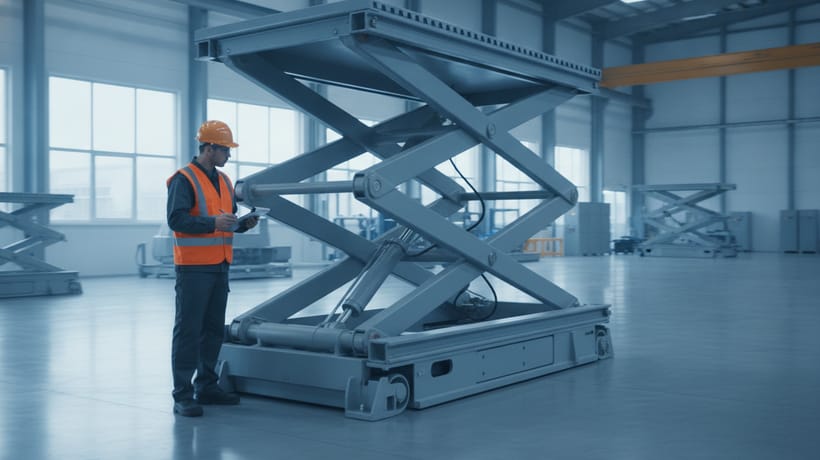
The employer bears overall responsibility for occupational safety in the business. Applied to lifting equipment, the Swiss National Accident Insurance Fund (SUVA, Schweizerische Unfallversicherungsanstalt) puts it plainly: as the operator of a lifting device, you must ensure proper servicing and maintenance. This duty can be broken down into several building blocks, all of them anchored in Swiss law.
- Use as intended: Under VUV Art. 32a, work equipment may only be used for tasks and at locations for which it is suitable. The manufacturer's instructions must be taken into account.
- Observe the load capacity: A piece of work equipment must be designed for the load. The load capacity must, where necessary, be marked clearly and visibly and must not be exceeded (VUV Art. 25).
- Only in a safe operating condition: Equipment may only be used in a safe operating condition. Defects that compromise safety must be remedied before the next use.
- Trained personnel: Employees who use lifting equipment such as a scissor lift table must be trained in its operation.
- Qualified maintenance: During maintenance and cleaning work, all necessary protective measures must be taken. The maintenance must be carried out by suitably instructed or trained persons (VUV Art. 37 para. 2).
These duties apply on an ongoing basis, not only at first commissioning. They are addressed to the operator and remain in force for as long as the lift table is in use.
Maintenance: inspection, servicing and repair
What "maintaining" concretely involves is described by EKAS Guideline 6512 in three components. The inspection establishes the condition, through measuring, testing and recording. Servicing covers the measures to preserve the target condition, such as cleaning and care. The repair restores the target condition through replacement or mending. The testing of a lift table is thus one part of the inspection component within overall maintenance.
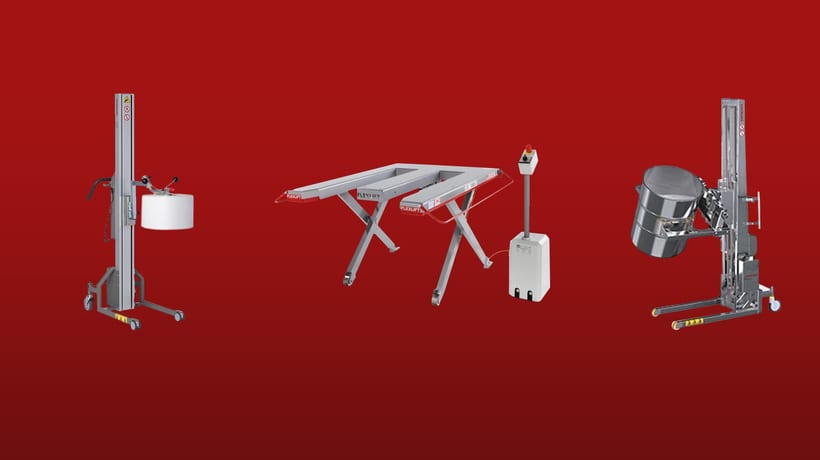
The legal benchmark for this is set out in VUV Art. 32b: work equipment must be properly maintained in line with the manufacturer's instructions, taking account of the particular purpose and place of use. In the operating manual the manufacturer provides the necessary information on maintenance, and this information is the basis for the scope and rhythm of maintenance. This also answers the frequently asked question about the inspection interval: the VUV names no fixed statutory interval. What is decisive are the manufacturer's instructions. Many manufacturers provide in their operating manuals for regular, often annual inspections; binding, however, is always the specific requirement for the equipment in use, not a blanket interval. For the Flexlift lift tables in our range this requirement is clear: after first commissioning, the operating manual calls for a regular inspection by a competent person at intervals of no more than one year. For lift tables intended to carry the person operating them, or that reach a lifting height of more than 2 m, it additionally requires that an inspection log be kept.
Hydraulic hoses: inspect annually, replace after six years at the latest
How concrete a manufacturer's instructions can become is shown by the hydraulic hoses. In the operating manuals for its lift table series, Flexlift prescribes two measures: the annual inspection of all hydraulic hoses for leaks, kinks, chafe marks, embrittlement and correct seating in the fittings, and the replacement of all hoses after six years at the latest, even if no damage or wear is visible from the outside. In multi-shift operation the maintenance intervals are halved.
In Switzerland such requirements are not mere recommendations: under Art. 32b VUV, work equipment must be maintained in line with the manufacturer's instructions, and the measures must be documented. Record the installation date of each hose in writing, therefore, because only in this way can the six-year limit be evidenced at a check.
The limit is also in line with the recognised rules of technology: the standard DIN 20066 recommends a service life of no more than six years for hydraulic hose lines, including a storage period of no more than two years. Anyone having a hose replaced is therefore well advised to check its date of manufacture as well.
Documentation: who, what and when
Maintenance must not only be carried out, but also documented. VUV Art. 32b expressly requires that the maintenance be documented. SUVA locates this duty for lifting equipment unmistakably: the maintenance measures must be documented as a matter of law (Ordinance on the Prevention of Accidents, Art. 32b para. 1).
How the documentation should look is specified by the EKAS guidance: the documentation must make clear who maintained what and when. A written inspection report with the date, the person carrying out the work and the tasks performed meets this requirement and is at the same time the proof a business can present at a check.
Who inspects? SUVA, cantonal inspectorates and EKAS
SUVA is one of the enforcement bodies of the UVG. Through business inspections it checks compliance with the safety provisions and advises businesses on prevention. The responsibility is divided by risk: businesses with high risks are supervised by SUVA under Art. 49 VUV, while the cantonal labour inspectorates are responsible in the remaining businesses. The prevention of occupational diseases is supervised by SUVA in all businesses (Art. 50 VUV). Above all this stands EKAS, the Federal Coordination Commission for Occupational Safety, which coordinates the various enforcement bodies and ensures a uniform application of the provisions.
Standard testing (EN 1570) and in-service inspection: two levels
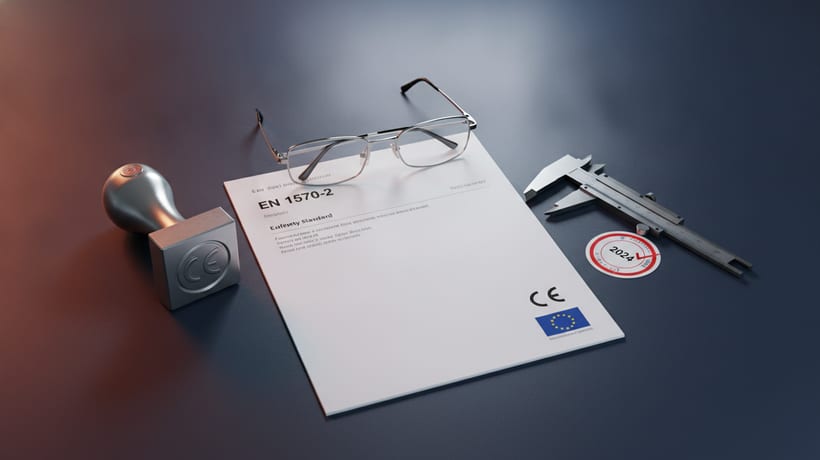
Two inspection concepts circulate around lift tables that are easily confused. On the one side is the safety standard EN 1570, a Type C standard for lift tables, which SUVA also lists in its factsheet on the important Type C standards for lifting platforms. This standard is addressed to the manufacturer: EN 1570-1 defines construction and equipment requirements and forms the basis for conformity under VUV Art. 24 para. 2. It is thus the level of procurement and of placing on the market.
On the other side stand the operator obligations in ongoing operation, that is use as intended, maintenance and documentation under VUV Art. 32a and 32b as well as EKAS Guideline 6512. A machine that is built to standard and is CE-compliant therefore does not release the operator from the recurring inspection and the documentation in operation, because the two are different levels. Which constructional requirements the standard sets, in particular where there are several fixed landings, is explained in detail in our article EN 1570-2 explained.
Requesting an inspection: Switzerland-wide and manufacturer-independent
The inspection and maintenance of a lift table can be organised internally or handed to a service provider. Tirugo carries out inspections across Switzerland and independently of the manufacturer, including the recurring annual inspection in the rhythm set by the manufacturer, and issues a written inspection report that meets the documentation requirement under VUV Art. 32b. A lift table can thus be operated in a SUVA-compliant manner when its use, maintenance and documentation follow the Swiss framework. The scope and rhythm follow the manufacturer's instructions and your operating situation. We are happy to clarify the details and a suitable date on request via our Service & Maintenance page.
Frequently asked questions about lift table inspection
Is there a statutory inspection requirement for lift tables in Switzerland?
The UVG (Federal Accident Insurance Act, Art. 82) and the VUV oblige the employer to keep work equipment safe. Under Art. 32b VUV, a lift table must be maintained properly in line with the manufacturer's instructions, and this maintenance must be documented. The VUV does not name a fixed statutory inspection interval; what is decisive are the manufacturer's instructions in the operating manual.
Do the German DGUV and UVV rules also apply in Switzerland?
No. DGUV rules, the German Ordinance on Industrial Safety and the UVV are German regulations. In Switzerland the UVG, the VUV and the EKAS guidelines apply instead. The German DGUV Principle 308-002 on the inspection of lifting platforms has no validity in Switzerland.
How often must a lift table be inspected?
The VUV does not prescribe a fixed interval. The scope and rhythm of maintenance follow the manufacturer's instructions in the operating manual (Art. 32b VUV). Many manufacturers provide for regular, often annual inspections; binding in each case are the specific manufacturer's instructions for the equipment in use. For Flexlift lift tables, the operating manual calls for a regular inspection by a competent person at intervals of no more than one year.
What does SUVA-compliant mean for lift table inspection?
SUVA-compliant means that operation, maintenance and documentation follow the Swiss framework of UVG, VUV and EKAS Guideline 6512. If the employer follows the guideline, it is presumed that they meet the occupational safety provisions concretised there. Tirugo inspects across Switzerland and independently of the manufacturer and issues a written inspection report.
How long may hydraulic hoses on a lift table be used?
Flexlift's operating manual requires all hydraulic hoses to be replaced after six years at the latest, even if no damage is visible from the outside. Until then, the hoses must be inspected annually. These manufacturer's instructions are decisive for operators in Switzerland, because under Art. 32b VUV work equipment must be maintained in line with the manufacturer's instructions.
Would you like to organise the inspection of your lift tables or clarify an open question about your operator obligations? We support you independently of the manufacturer and across Switzerland. Submit your enquiry.