The packing table decides whether goods leave the building quickly, cleanly and without back pain. Hundreds of times per shift, items are picked up, folded, filled, taped and set down. A good packing table keeps these movements short and the posture upright. This guide explains what matters for a packing table in logistics: working height, load capacity, surface, mobility and accessories. For transparency: Tirugo does not carry its own packing tables. A height-adjustable PETec table can, however, be used as a packing table, and for many companies this height adjustment is exactly what makes the difference.
What makes a good packing table?
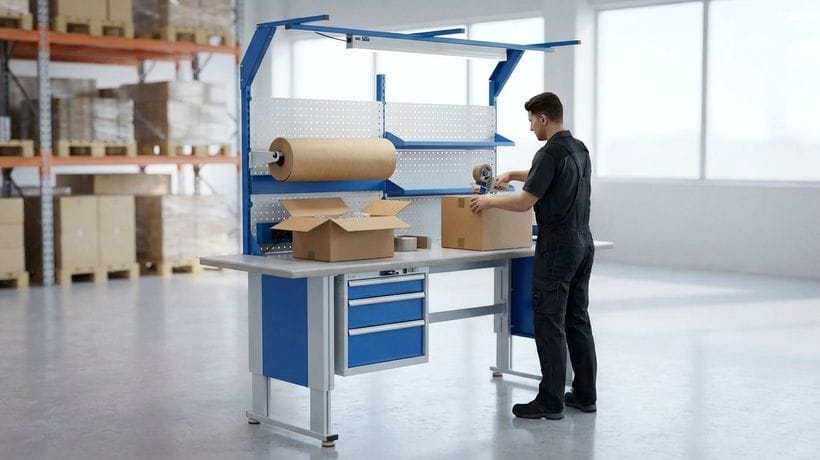
A packing table is a workstation where goods are packed, labelled and prepared for shipping. Classic packing tables are system furniture with a fixed or step-adjustable height and add-ons for cartons, filling material and label printers. Five criteria determine whether a packing station works in daily practice:
- Working height: matched to the person and to the size of the parcels.
- Load capacity: sufficient for the heaviest shipments and for the add-ons.
- Surface: enough space for carton, goods and material without long reaches.
- Mobility: fixed in place or mobile, depending on layout and flow of goods.
- Accessories: material within reach, so that no searching or bending is needed.
This distinguishes the packing table from the assembly table: at the packing station, parcel sizes and people change by the minute, while at the assembly station the assembly, load capacity and precision come first. If you are looking for a table for assembly or inspection, you will find the right criteria in our guide Assembly tables for industry.
Working height and ergonomics at the packing station
Working height is the most important and most often underestimated factor. Packing alternates light tasks such as folding and labelling with strenuous ones such as closing large cartons. Light work is roughly at elbow height, strenuous work lower so that body weight can help. For standing work, DIN EN ISO 14738 gives a guideline of around 95–115 cm depending on the task. Parcel size comes on top: a tall carton shifts the actual working height upwards, so the table top should then be lower.
A fixed packing table cannot cover this range, especially not in shift work with employees of different heights. Packing too low means working bent over. Packing too high means raising the shoulders. Over a shift, this adds up. A height-adjustable packing table lets each person set the right height and readjust it for changing parcel sizes.
Lifting is also part of the packing station. As guideline values for occasional lifting, SUVA gives 25 kg for men and 15 kg for women. If lifting occurs more than 4 times per hour, an assessment of the strain is required from as little as 12 kg and 7 kg respectively. What this means for workstation design is explained in our guide Preventing musculoskeletal disorders in the workplace.
Sizing load capacity and surface correctly
A packing table carries more than one parcel. Goods, carton stock and filling material lie on the top, scales or printers often stand on it, and heavy shipments are not always set down gently. The load capacity should therefore cover the heaviest parcel plus add-ons, with a reserve.
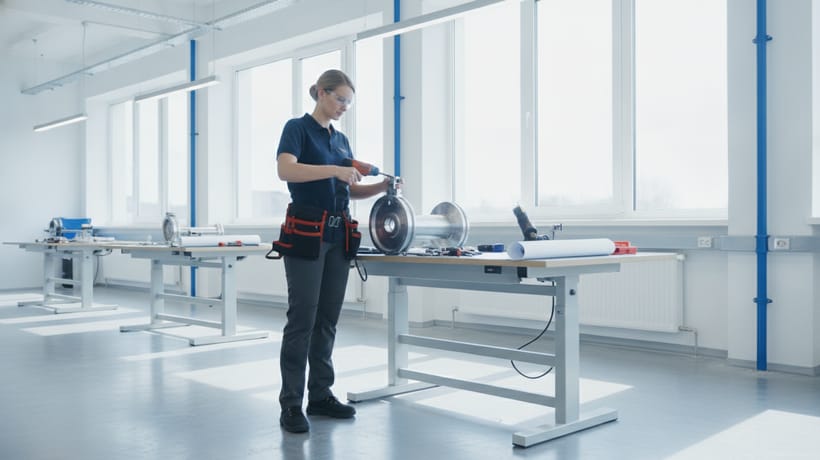
PETec ergonomic tables are steplessly height-adjustable and, depending on the line, carry from 300 kg (Mono) up to 12 t (Advanced). For typical packing stations, the PETec Basic with two height-adjustable legs and a load capacity of up to 750 kg is often sufficient. Anyone packing heavy industrial goods will find a solution up to 12 t in the PETec Advanced with four synchronously adjusted legs. For the surface: large enough for the biggest carton and its contents, but compact enough to keep everything within reach without taking a step. Because PETec tables are made to measure, the top dimensions can be matched to the parcel range. All models are shown in the overview of height-adjustable PETec tables.
Mobile or fixed in place?
In many warehouses, the layout changes with the season or with new customers. A mobile packing table then follows the flow of goods instead of slowing it down. Castors are standard on the PETec Ecoline and optional on Basic, Advanced and Professional. PETec tables can also be moved while loaded: a fully packed order can be rolled to the shipping area together with the table, without reloading. Read more about mobile tables in the guide Lift table trolley or mobile lift table?
Drive: electric or mechanical?
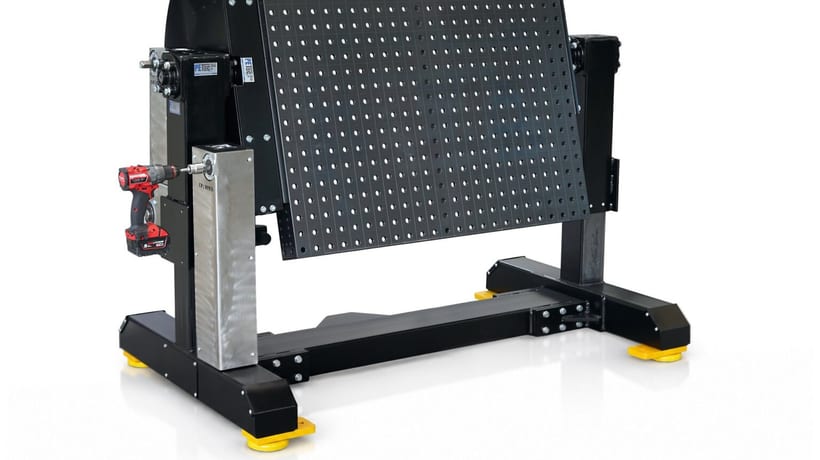
How often the height is changed determines the right drive. If people or parcel sizes change several times per shift, electric adjustment via 230 V or battery is convenient. If the height is set once per person and then stays, mechanical adjustment by hand crank or cordless screwdriver is sufficient. The PETec Basic is available in all these versions. The patented spindle-chain drive works without hydraulics: there is no oil that could soil goods or packaging.
Accessories and organisation at the packing station
A good packing station has everything within reach: cartons, filling material, tape, labels and scanner. Classic packing table systems offer add-ons such as roll holders, shelves or mounts for printers and screens. At PETec, for example, the Advanced is optionally available with drawers. Which further add-ons can be implemented for your packing station is clarified case by case. Regardless of the table: what is used often belongs in the near reach zone, stock in the wider area or under the top.
Combining packing table and lift table in logistics
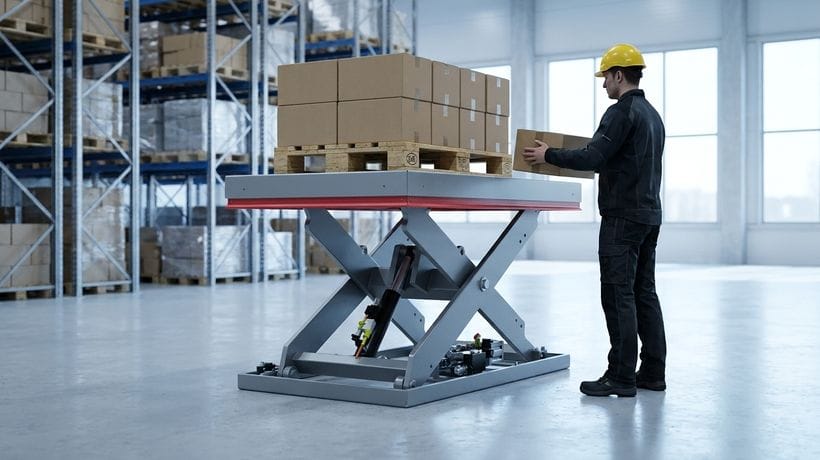
Anyone packing directly from the pallet has a second height problem: the top layer is comfortable, the bottom one is on the floor. This is where a lift table complements the packing table. It raises the pallet layer by layer to gripping height, so that no bending is needed between pallet and packing table. Low-profile lift tables can be installed without a pit and loaded close to the floor. Solutions for warehouse and shipping are shown on our page Lift tables for logistics and intralogistics.
Buying a PETec table as a packing table in Switzerland
Tirugo is the authorised PETec distributor and delivers throughout Switzerland. For selected PETec models, delivery starts from 7 days. Our demonstration models are currently being tested by customers; on request, we are happy to check whether we can provide you with a test model. For the quotation, we need the heaviest parcel, the desired top size, the height range, the type of drive and whether the table should be mobile.
Frequently asked questions about packing tables
What height should a packing table be?
There is no single ideal height. As a standards-based guideline for standing work, DIN EN ISO 14738 gives around 95 to 115 cm depending on the task. Light work is roughly at elbow height, strenuous work lower, and tall cartons shift the working height upwards. A height-adjustable packing table can be adapted to all of this.
Does Tirugo sell packing tables?
Tirugo does not carry its own packing tables. However, a height-adjustable PETec table can be used as a packing table. It adjusts steplessly, is made to measure and, depending on the model, is available with castors.
What load capacity does a packing table need?
What counts is the heaviest parcel, the goods and add-ons such as scales or printers, plus a reserve for setting loads down. Depending on the line, PETec ergonomic tables carry from 300 kg (Mono) up to 12 t (Advanced); the PETec Basic carries up to 750 kg.
Does a packing station have to be ergonomic?
According to the SECO guidance on ArGV 3, employers must provide suitable work equipment for moving loads. Where parcels are lifted more than 4 times per hour, SUVA requires an assessment of the strain from as little as 12 kg for men and 7 kg for women.
Would you like to make your packing stations more ergonomic or replace a fixed packing table with a height-adjustable solution? We clarify parcel range, load capacity and height range with you and propose the right PETec table. Submit your enquiry.