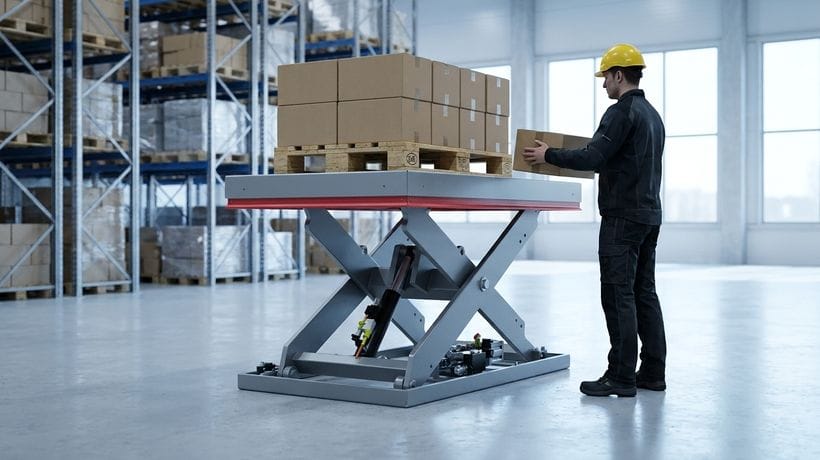
Pallets arrive at floor level, but people work at hip height. Anyone picking cartons from a pallet, building up layers or removing parts has to bend down for almost every grip when the pallet sits on the floor. The obvious solution: raise the pallet. Pallet lifters and pallet lift tables are available for this. The terms are often used interchangeably but describe different classes of equipment. This guide shows which solutions exist, where their strengths and limits lie and why a flat form lift table that can be driven onto with a hand pallet truck is the right answer for many workstations.
Why pallets belong at working height
If the top layer of a pallet is too low or too high, every grip forces the worker to bend or stretch. Repetitive bending causes chronic complaints and costly absences. A lifting device keeps the picking level at a favourable gripping height instead: deep bending and working above shoulder height are eliminated, posture stays even and the strain on back and shoulders is reduced. The elbow height of the employees serves as a guide for the right height. You will find background on strain and prevention in our article on musculoskeletal disorders in the workplace.
Pallet lifters: which devices are meant
In everyday use, the term “pallet lifter” covers several types of equipment:
- Scissor lift pallet trucks: a hand pallet truck that additionally raises the pallet via scissors. It combines transport and lifting but remains a manual device.
- Spring-loaded levellers: they lower under the weight of the pallet and raise it again as each layer is removed, without any drive.
- Forklifts and high-lift trucks: they raise the pallet, but they are conveying equipment, not a workstation.
- Pallet lift table: a powered lift table whose platform is designed for pallets and which brings the pallet to the required height via its control.
Where simple pallet lifters reach their limits
Manual devices are quick to hand and need no power connection. In continuous use, however, their drawback shows: repeated pumping is tiring and takes time, and they are not intended to be integrated into a fixed workstation. Spring-loaded levellers work without power but are matched to a specific load range; if the pallet weight changes significantly, the height no longer fits. A forklift holding the pallet on its forks during work is blocked for other tasks, and working under a raised load should be avoided.
As soon as pallets are handled regularly, with varying weights or at a fixed workstation, a powered lift table is the more stable solution. Tirugo does not sell manual scissor lift pallet trucks and focuses on these lift tables.
The flat form lift table as a pallet lift table
A flat form lift table is so low that it can stand on the hall floor without a pit. Flexlift flat form lift tables start at an overall height from 55 mm and cover load capacities from 300 to 8,000 kg across the range. This allows the pallet to be taken over directly at floor level and then raised to working height. All series in detail are on our page flat form lift tables FE, F-CE, FM and FMA.
FE: the lift table for Euro pallets
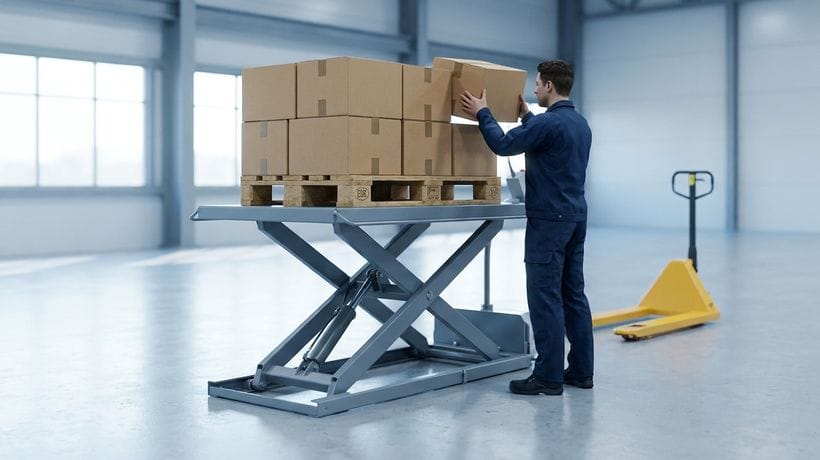
The FE series specialises in Euro and special pallets. The platform is barely larger than a Euro pallet; the standard width is 910 mm, 1,150 mm is available for industrial pallets, and special widths on request. The E-shaped platform supports all three skids of the pallet, and its recess allows a hand pallet truck to drive straight in at floor level and set the pallet down. Load capacity ranges from 300 to 2,000 kg, and the pallet can be raised to an ergonomic working height. Because the platform is so compact, reaching distances are short from all sides, and thanks to free foot space the operator can stand comfortably at the table.
FE-A and FE-M: variants for the workstation
On the FE-A, the hydraulic power unit and control are mounted directly on the platform, and power comes from above via a spiral cable. This keeps cables off the floor at the workstation, and the control arm can be swivelled by approx. 180 degrees towards the operator. The FE-M adds attachment modules to the platform: a turntable that rotates 360 degrees, a roller conveyor attachment or a container tilter with 17 to 25 degrees of tilt. With the turntable, the pallet can be turned towards the operator instead of the operator walking around it. Both variants carry 300 to 2,000 kg on a 910 × 1,300 mm platform.
F-CE, FM and FMA: closed platform, heavy loads, trolleys
The F-CE series with a closed rectangular platform carries 300 to 2,500 kg and reaches lifting heights of up to 950 mm. With the optional short drive-on ramp, pallet trucks and forklifts drive directly onto the platform without a pit. If more capacity is needed, the narrow FM series offers load capacities from 500 to 8,000 kg with platform widths from 500 mm. If goods arrive on trolleys rather than pallets, the FMA is the right design: its E- or U-shaped platform takes the transport trolley directly and brings it to working height without a ramp or pit, with load capacities from 500 to 1,500 kg.
Pallet lifter and pallet lift table compared
| Solution | Strength | Limit |
|---|---|---|
| Scissor lift pallet truck | Transport and lifting in one device, no power needed | Manual, tiring in continuous use (not in the Tirugo range) |
| Spring-loaded leveller | Raises layer by layer automatically | Matched to one load range |
| Forklift | Takes the pallet anywhere | Conveying equipment, not a workstation |
| FE flat form lift table | Hand pallet truck drives in at floor level, 300–2,000 kg, height freely selectable | Needs power, fixed workstation or castor option |
| FM flat form lift table | Heavy loads 500–8,000 kg, narrow design | Configured per project |
How does the pallet get onto the table?
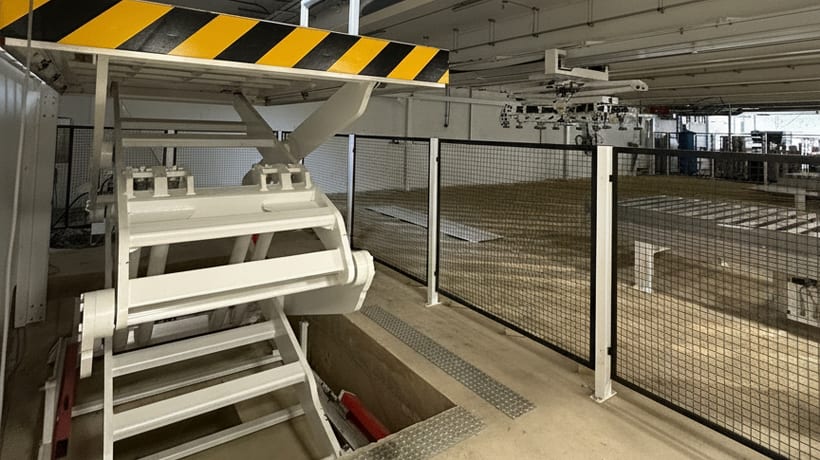
The way the table is loaded determines the design. With a hand pallet truck, you drive into the FE at floor level thanks to the E-shape. On the F-CE, the drive-on ramp does this job. If the platform should be flush with the hall floor, pit installation is the solution: pallet trucks and forklifts drive on without a ramp, and for drive-over versions there are platform reinforcements for up to 6 tonnes wheel load. Our guide on lift table pit installation explains what matters. In any case, every Tirugo lift table can be picked up by a forklift and relocated that way.
Selection criteria for a pallet lift table
- Pallet format: Euro pallet (standard width 910 mm), industrial pallet (1,150 mm) or special format.
- Weight: maximum weight of the loaded pallet plus a reserve for setting it down.
- Loading: hand pallet truck, forklift or trolley.
- Working height: to what height should the pallet go, and does it change as layers are removed?
- Installation: free-standing on the floor, with a drive-on ramp or in a pit.
- Drive and power: the FE is available with a hydraulic or electromechanical drive; the FMA runs on 400 V only.
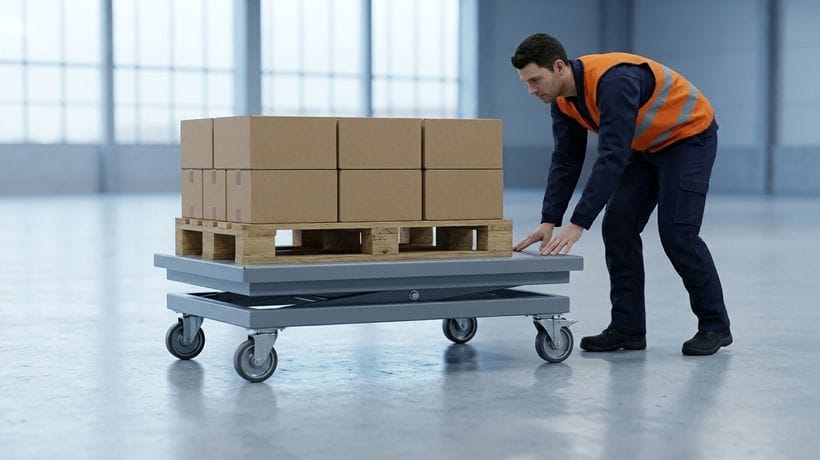
- Mobility: the FE can also be ordered as a mobile version with four castors and a lever roller.
Our guide Lift table trolley or mobile lift table? shows how a mobile lift table works in everyday use. The article Lift tables in intralogistics describes how pallet lift tables are integrated into order picking and material supply. If you are handling individual crates, containers or drums rather than whole pallets, the TransOrt MobilLift mini lifts are an alternative: they lift up to 400 kg, are electrically driven and mobile.
Frequently asked questions about pallet lifters and pallet lift tables
What is the difference between a pallet lifter and a pallet lift table?
Pallet lifter is a collective term for devices that raise a pallet, such as scissor lift pallet trucks or spring-loaded levellers. A pallet lift table is a powered lift table whose platform is designed for pallets and which brings the pallet to the required working height via its control.
Can I drive the pallet onto the lift table with a hand pallet truck?
Yes, with the Flexlift FE flat form lift table. The recess in the E-shaped platform allows a hand pallet truck to drive straight in at floor level and set the pallet down. The platform supports all three skids of the Euro pallet.
How much can a flat form lift table for pallets carry?
The FE series for Euro and special pallets carries 300 to 2,000 kg. Across the entire Flexlift flat form range, load capacities range from 300 to 8,000 kg; the heaviest loads are handled by the narrow FM series.
Does a pallet lift table need a pit?
Not necessarily. Flat form lift tables start at an overall height from 55 mm and can stand on the hall floor; the F-CE series is also available with a drive-on ramp. If the platform should be flush with the floor, pit installation is possible.
Does Tirugo sell manual scissor lift pallet trucks?
No, Tirugo does not sell manual scissor lift pallet trucks. For ergonomic pallet lifting, we offer powered Flexlift flat form lift tables, also as mobile versions on request. We are happy to check which solution suits your workstation.
Would you like to bring pallets to an ergonomic working height at a workstation? We clarify pallet format, weight, loading and installation with you and recommend the right flat form lift table. Submit your enquiry.