Lifting crates off shelves, heaving components onto the workbench, bringing pallets up to working height, pouring from drums: in many companies, loads are lifted by hand every day that a lifting aid could handle. But there is no single lifting aid for everything. Depending on the load, the movement and the place of use, a different device fits: a mobile lifting aid that travels to the load, a lift table that brings whole pallets to working height, or a height-adjustable work table that adapts the workstation to the person and the workpiece. This guide explains the three types, sets out the key selection criteria and shows the role SUVA reference values play in the decision.
What is a lifting aid?
A lifting aid is a technical device that takes over or eases the lifting, lowering, holding or moving of loads for employees. The term is deliberately broad: it ranges from the mobile mini lift for crates and containers to the lift table for pallets and the work table that brings a heavy workpiece smoothly to the right height. All of them share one principle: the load reaches the right height before a person handles it, and the body no longer has to supply the force.
Why lifting aids? Ergonomics and the Swiss framework
Lifting and carrying are among the most common causes of back problems at work. Guidance on when it becomes critical comes from SUVA publication 88190 on assessing physical strain when lifting and carrying loads. As reference values for occasional lifting, it gives 25 kg for men and 15 kg for women. If lifting takes place more than four times per hour, an assessment is required from 12 kg for men and from 7 kg for women. Many everyday tasks in the warehouse, in assembly or in the laboratory reach these thresholds faster than you might think.
On top of this comes the employer's duty: the SECO guidance on Ordinance 3 to the Employment Act states in relation to Art. 25 that suitable work equipment must be provided for moving loads. Technical measures take priority over organisational ones such as job rotation or breaks, because they work in every shift. A lifting aid is exactly such a technical measure. You can read more about reference values and the hierarchy of measures in our article on preventing musculoskeletal disorders in the workplace.
Three types of lifting aids at a glance
Mobile lifting aid: the mini lift comes to the load
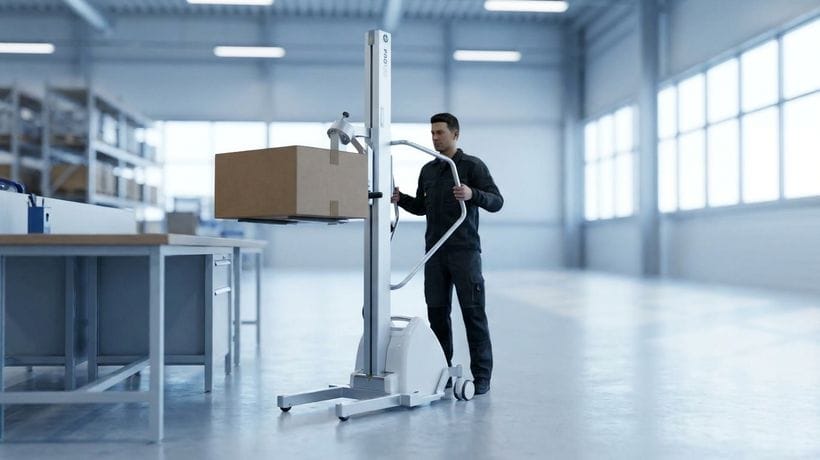
A mobile lifting aid is a lifting device on wheels that is taken to wherever the load is. For this, Tirugo supplies the MobilLift devices made by TransOrt GmbH of Schmallenberg, which has been developing and manufacturing ergonomic lifting aids for in-house use since 1998. All MobilLift models are mobile and AGR-certified (Campaign for Healthier Backs). Depending on the model and attachment, they can lift, lower, tilt, pour, rotate, swivel, grip and move.
- MobilLift Impact 80: up to 80 kg load capacity, compact and lightweight, ideal for precision assembly and laboratories.
- MobilLift Impact 200: up to 200 kg load capacity, lifts, lowers, tilts and rotates, for assembly and logistics.
- MobilLift K16: up to 400 kg load capacity, electrically driven, robust for continuous use in order picking and transport.
The biggest difference comes from the interchangeable attachments: forks, platforms, grippers, suction cups, turntables or a swivel arm turn the base unit into a multi-purpose lifting aid. Typical applications are lifting and positioning crates and containers, mobile roll handling, where rolls and coils are lifted and rotated, and drum handling. How drums are lifted, rotated and tipped with the MobilLift is covered in our guide lifting, rotating and tipping drums safely. All models and attachments are on our page on the TransOrt MobilLift mobile lifting aid.
Lift table: pallets and heavy loads at working height
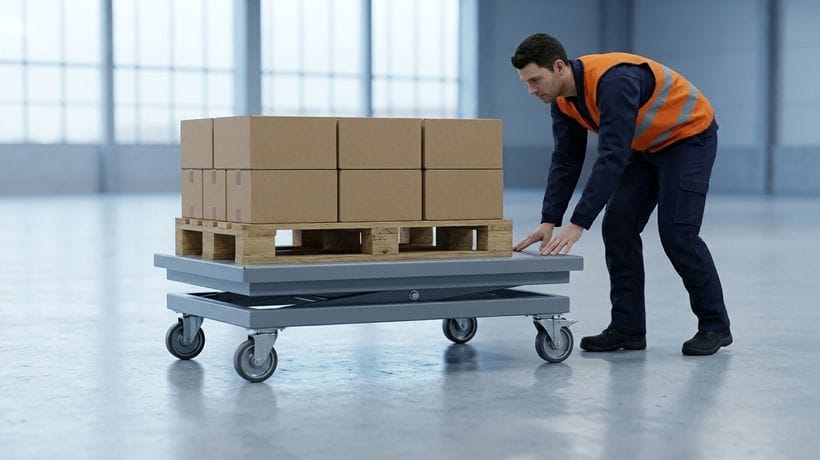
When it is not single crates but whole pallets, mesh boxes or heavy components that need to reach working height, the lift table is the right lifting aid. It raises the entire load unit so that employees work layer by layer at a comfortable gripping height instead of bending down to the bottom of the pallet. Tirugo's lifting table range covers load capacities from 100 to 12,000 kg, from compact designs to flat form. Our page on lifting tables for industry and trade gives an overview of designs and capacities. If the lift table needs to change location, the Flexlift FE flat form series with load capacities from 300 to 2,000 kg can also be ordered in a mobile version. The differences from manual solutions are explained in lift table trolley or mobile lift table.
Height-adjustable work table: the workstation adapts
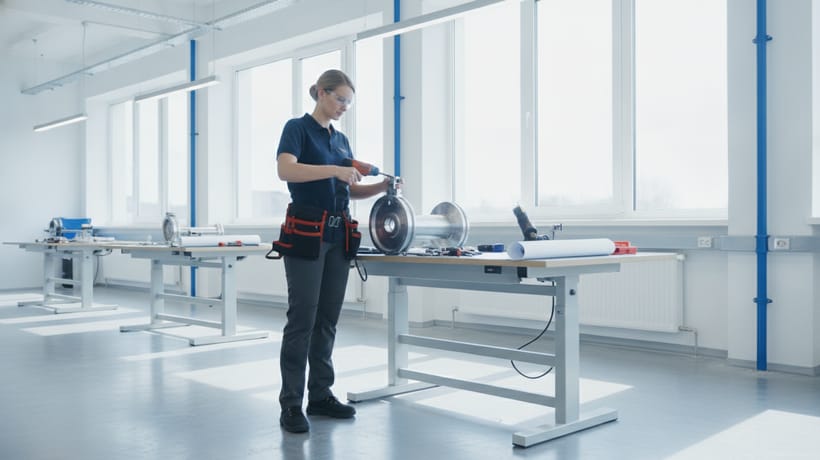
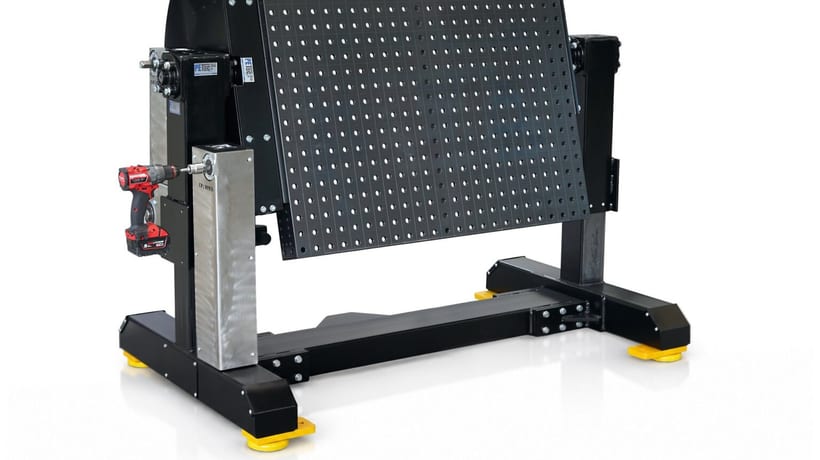
The third form of lifting aid does not lift the load to the person but brings the whole workstation to the right height. A height-adjustable work table is suitable wherever a workpiece is machined, assembled or inspected on the table. PETec ergonomic tables are infinitely height-adjustable, use a spindle-chain drive without hydraulics and, depending on the line, carry from 300 kg (Mono) and 750 kg (Basic) up to 12 t (Advanced). They can also be moved when loaded. Find out more on our page on PETec height-adjustable assembly tables.
Selection criteria: how to find the right lifting aid
Which lifting aid fits comes down to a few clear questions:
- Load: How heavy is the load and what shape is it? A crate, a roll, a drum, a pallet or a bulky component each place different demands on the pick-up and the load capacity.
- Movement: Does the load only need to be raised and lowered, or also tilted, rotated, swivelled or gripped? Additional movements need a suitable attachment.
- Mobility: Does the lifting aid stay at a fixed station, or should it travel to the load? A mini lift is mobile; a lift table is usually stationary but can be supplied in a mobile version.
- Frequency: How often is lifting done per day? The SUVA thresholds for frequent lifting are a good indicator of where a lifting aid brings the greatest benefit.
- Environment: Laboratory, assembly, warehouse or order picking: space, routes and the type of work determine size and equipment.
Decision guide: task and matching lifting aid
| Task | Matching lifting aid |
|---|---|
| Lifting and positioning crates and containers in precision assembly or the laboratory | MobilLift Impact 80, up to 80 kg |
| Lifting, tilting or rotating loads in assembly and logistics | MobilLift Impact 200, up to 200 kg |
| Lifting and moving heavy loads, order picking and transport | MobilLift K16, up to 400 kg |
| Lifting and rotating rolls and coils | MobilLift with a roll handling attachment |
| Lifting, rotating and tipping drums | MobilLift with a drum attachment |
| Pallets and heavy load units at working height | Lift table, range from 100 to 12,000 kg |
| Working on a workpiece at an individual height | PETec work table, 300 kg to 12 t |
Lifting aids for private customers too
Lifting aids are not only a topic for industrial companies. Tirugo supplies MobilLift mini lifts to businesses and private customers alike, for example for a home workshop. In both cases you receive advice, quotation, delivery and service from a single source, across all of Switzerland.
Frequently asked questions about lifting aids
What is a mobile lifting aid?
A mobile lifting aid is a lifting device on wheels that is taken to the load, instead of carrying the load to a fixed device. All TransOrt MobilLift models are mobile and, depending on the model, lift up to 80 kg, up to 200 kg or up to 400 kg. With interchangeable attachments they can also tilt, rotate, swivel or grip the load.
When is a lifting aid worthwhile?
The SUVA reference values are a good guide: for occasional lifting they are 25 kg for men and 15 kg for women. If lifting takes place more than four times per hour, an assessment of the strain is required from 12 kg or 7 kg respectively. Wherever such tasks occur regularly, a lifting aid noticeably relieves employees.
Which lifting aid is suitable for pallets?
For whole pallets, a lift table is the right lifting aid. It raises the entire load unit to working height so that work is done layer by layer at a comfortable gripping height. Tirugo's lifting table range covers load capacities from 100 to 12,000 kg, and individual series are also available in mobile versions.
Can private customers buy a lifting aid from Tirugo?
Yes. Tirugo supplies TransOrt MobilLift mini lifts to businesses and private customers alike, with advice, quotation, delivery and service across all of Switzerland.
What does AGR-certified mean?
Certification by the Campaign for Healthier Backs (Aktion Gesunder Rücken e.V.) confirms that MobilLift devices are ergonomically designed and demonstrably relieve spinal strain. This is an important factor in SUVA workplace assessments in Switzerland.
Would you like to know which lifting aid suits your task? Describe the load, the movement and the place of use, and we will suggest the right solution and check on request whether a test unit is available for your application. Submit your enquiry.