The most important safety standard for lift tables has a new edition: EN 1570-1:2024 replaces the previous EN 1570-1:2011+A1:2014. It is now listed as a harmonised standard under the Machinery Directive, and the transition period for the old edition ended in March 2026. In German-speaking markets it often appears as “DIN EN 1570-1”, the name of the German version. This article summarises which lift tables the standard covers, what has changed and what buyers and operators in Switzerland should look out for now. The information is based on publicly available sources from CEN, DIN, SNV and the Official Journal of the EU; the text of the standard itself remains authoritative.
EN 1570-1:2024 at a glance
- Prepared by: Technical Committee CEN/TC 98 “Lifting platforms”, whose secretariat is held by DIN.
- Supersedes: EN 1570-1:2011+A1:2014. National standards bodies had to adopt the new edition by October 2024 at the latest and withdraw conflicting national standards.
- German version: DIN EN 1570-1:2024-07, which replaces DIN EN 1570-1:2015-01.
- Switzerland: SNV lists the standard as SN EN 1570-1:2024 (edition April 2024); SN EN 1570-1+A1:2014 has been withdrawn.
- Harmonised: Commission Implementing Decision (EU) 2024/2408 of 13 September 2024, published in the Official Journal of the EU on 16 September 2024, added the reference of EN 1570-1:2024 under Machinery Directive 2006/42/EC.
- Old edition: The withdrawal of the reference to EN 1570-1:2011+A1:2014 applies from 16 March 2026.
Which lift tables does Part 1 cover?
According to its scope, EN 1570-1:2024 applies to lift tables that serve no more than two fixed landings but may pass a fixed landing, and whose vertical travel speed does not exceed 0.15 m/s, unless the lift table is safe by position. It covers lift tables for raising and lowering goods, with or without operators or authorised persons, as well as lift tables that raise operators to a working position, provided the platform is guided throughout its vertical travel.
Explicitly excluded are, among others:
- lift tables serving more than two fixed landings of a building for goods: these are covered by EN 1570-2:2016, which we explain in EN 1570-2 Explained;
- lift tables raising operators to more than two fixed landings;
- scissor lift pallet trucks to EN ISO 3691-5, i.e. the classic lift table trolleys (see our guide Lift Table Trolley or Mobile Lift Table?);
- mobile elevating work platforms (EN 280-1), vehicle lifts (EN 1493) and lifting tables for stage and performance use (EN 17206);
- lift tables used on ships and lift tables suspended from a ceiling.
For goods lifts, the rule of thumb is simple: up to two fixed landings means Part 1, more than two landings means Part 2.
The twelve changes compared with the 2011+A1:2014 edition
The European foreword of the standard lists twelve main points of the revision. In summary:
- Restructured: the document has been completely reorganised.
- Wider scope: lift tables in non-industrial applications, static elevating work platforms and lift tables used in skillet lines or on autonomous ground vehicles (AGV) are now included.
- Passing a landing, carrying persons: a lift table may pass a fixed landing and carry authorised persons while under operator control.
- Rated and structural loads: both load terms have been introduced.
- Flow charts instead of a table: the former Table 3 on safeguards has been replaced by flow charts in Annex I, a guide to travel zone risks.
- Falls by height of fall: where appropriate, the risk of falling is now linked to the actual height of fall rather than the travel height of the machine.
- Publicly accessible areas: greater emphasis is placed on protecting the public when lift tables are used there.
- Barriers and guard-rails: boom barriers have been reintroduced, and interlocking and locking requirements for removable guard-rails have been clarified.
- Upper landing: the lift table must be locked when it is at an upper fixed landing.
- Overload monitoring: the limits have been relaxed because suitable state-of-the-art equipment is lacking.
- Hydraulics: the use of pipe rupture protection devices in hydraulic systems is restricted.
- Drives: rigid and pusher chains have been introduced, pneumatic drives removed.
How these points apply in an individual case follows from the text of the standard and the manufacturer’s risk assessment. If you are defining the load for a new lift table, our guide Sizing a scissor lift table correctly explains rated load, off-centre load and load centre of gravity.
Transition period: what has applied since 16 March 2026
Harmonised standards are voluntary but have an important effect: a machine built to a harmonised standard whose reference is published in the Official Journal of the EU is presumed to meet the essential requirements covered. For EN 1570-1:2024 this presumption of conformity has applied since publication on 16 September 2024. To give manufacturers time to adapt, the reference to the old edition was not withdrawn immediately but only with effect from 16 March 2026.
In practice this means: anyone buying a new lift table today should find EN 1570-1:2024 listed as an applied standard in the declaration of conformity. For newly placed machines, a manufacturer can no longer rely on the old edition to establish the presumption of conformity. The standard addresses manufacturers and the placing on the market; for lift tables already in operation, operators in Switzerland are bound by the obligations under the UVG, the VUV and EKAS directive 6512.
Outlook: alignment with the EU Machinery Regulation
The next edition is already in the pipeline. A draft prEN 1570-1:2026 has been submitted to the CEN Enquiry and is intended to supersede EN 1570-1:2024. According to its foreword, the main points are a more detailed clarification of the borderline between EN 1570-1 and EN 280-1, incorporating the results of a gap analysis, and alignment with the new Machinery Regulation. The informative Annex ZA of the draft already refers to Regulation (EU) 2023/1230, which becomes applicable on 20 January 2027 and replaces the Machinery Directive.
In Switzerland, the Machinery Ordinance (MaschV) implements the requirements of Machinery Directive 2006/42/EC; SECO points out that the new EU regulation will be applicable from 20 January 2027. When the revised EN 1570-1 will be published and harmonised has not yet been determined.
What does this mean for buyers in Switzerland?
Before procuring a new lift table, five points are worth checking:
- Check the declaration of conformity: it lists the standards applied. Pay attention to the year of the edition: EN 1570-1:2024 is the current reference.
- Count the landings: does the installation serve no more than two fixed landings, or several levels? This determines whether Part 1 or Part 2 applies.
- Clarify the use by persons: will persons ride on or work from the platform? The standard sets specific requirements for this.
- State the location: if the lift table is installed in a publicly accessible area, the new edition requires greater protection. Mention this in your enquiry.
- Choose the drive deliberately: besides electro-hydraulic lift tables there are oil-free electromechanical solutions such as the SFL spindle lift table. Our lifting tables overview covers all types.
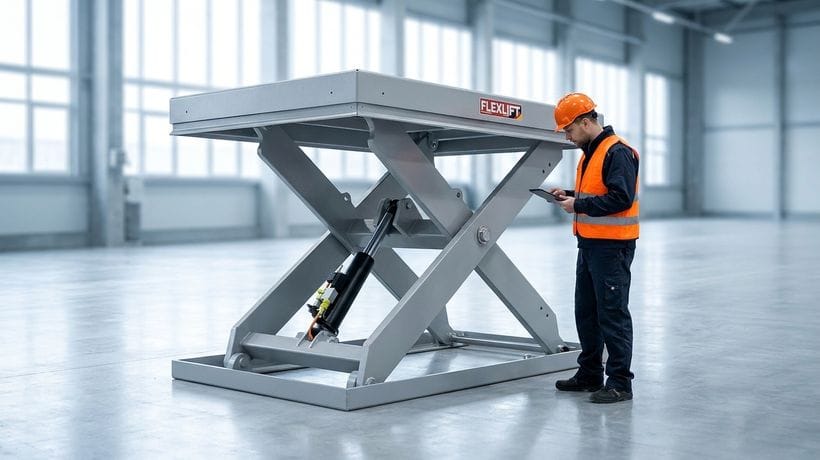
The Flexlift lift tables in the Tirugo range are manufactured CE-compliant under the Machinery Directive and, as scissor lift tables, follow EN 1570. We will gladly confirm with our quotation which edition of the standard is stated in the declaration of conformity for your model.
In operation: the link to inspection obligations
A new edition of the standard does not change the operator’s obligations. Under Art. 32b VUV, work equipment must be properly maintained in accordance with the manufacturer’s instructions, and maintenance must be documented. For Flexlift lift tables, the operating manual requires an inspection by a competent person at intervals of no more than one year. How the UVG, the VUV and EKAS directive 6512 interact is explained in our article Lift Table Inspection in Switzerland. We carry out inspections throughout Switzerland, independent of manufacturer, see Service & Maintenance.
Frequently asked questions about EN 1570-1:2024
What is EN 1570-1:2024?
EN 1570-1:2024 is the European safety standard for lift tables serving up to two fixed landings. It was prepared by CEN/TC 98 and supersedes EN 1570-1:2011+A1:2014. The German version is DIN EN 1570-1:2024-07, and in Switzerland SNV lists it as SN EN 1570-1:2024.
Is EN 1570-1:2024 a harmonised standard?
Yes. Its reference was published in the Official Journal of the EU on 16 September 2024 by Implementing Decision (EU) 2024/2408. Since then it has given a presumption of conformity with the covered requirements of Machinery Directive 2006/42/EC.
Does the old EN 1570-1:2011+A1:2014 still apply?
Its reference was withdrawn from the Official Journal with effect from 16 March 2026. Since then it no longer gives a presumption of conformity for newly placed lift tables. For lift tables already in operation, operators in Switzerland are bound by the obligations under the VUV and EKAS directive 6512.
What is the difference between EN 1570-1 and EN 1570-2?
EN 1570-1 applies to lift tables with no more than two fixed landings and a speed of up to 0.15 m/s. Lift tables that convey goods to more than two fixed landings of a building are covered by EN 1570-2:2016.
Planning a new lift table or wondering how your existing installation is classified? We clarify landings, use and location with you and propose a solution that complies with the standard. Submit your enquiry.